ADHD in Women and Girls: Why Diagnosis Comes Later—and What Better Care Looks Like
ADHD can be overlooked in girls and women because its signs do not always match the familiar stereotype of a restless boy disrupting class. Inattention, internal restlessness, masking, and co-occurring anxiety can make the condition harder to spot. Better recognition starts with understanding that ADHD varies from person to person.
Medical News Today’s In Conversation episode, “ADHD in women: Breaking the stereotypes,” puts the issue plainly: why are women often identified later, and does research reflect the range of real lives affected? The episode features Prof. Davida Hartman, a Chartered Educational and Child Psychologist with the Psychological Society of Ireland. MNT editor Maria Cohut also shares that she received an ADHD identification as an adult, recalling how ordinary multitasking seemed to her until a colleague pointed out how many things she was doing at once.
The episode cites a reported average diagnosis delay of five years for women compared with male peers. Treat that as a broad research finding, not a clock that applies to every person: estimates vary with the population studied, the definition of delay, and how researchers measure diagnosis. The more dependable point is that girls and women can spend years without an explanation that fits their difficulties. That delay can affect school, work, relationships, and self-trust. It is not proof that every missed difficulty is ADHD, either; careful assessment matters.
What Is ADHD in Girls and Women?
Attention-deficit/hyperactivity disorder (ADHD) is a neurodevelopmental condition involving a persistent pattern of inattention and/or hyperactivity-impulsivity that interferes with daily life. It begins during childhood, though a person may not receive a diagnosis until adolescence or adulthood. ADHD is not simply being distractible now and then, and it is not a measure of intelligence, care, or willpower. The National Institute of Mental Health describes ADHD as a condition that can affect attention, activity, and impulse control.
The familiar image of ADHD often centres on visible movement: a child leaving a seat, interrupting, or struggling to wait. That presentation exists, but it is only part of the picture. Someone may mainly lose track of instructions, forget appointments, have trouble starting or completing tasks, misplace essentials, or struggle to organise several steps. Another person may feel physically still but mentally restless, with thoughts jumping between unfinished jobs. What matters is the persistent pattern and its impact, not whether it looks noisy from across the room.
Girls and women are not a single clinical group. Some have obvious hyperactivity or impulsivity; others show prominent inattention, or a combination of symptoms that changes with age and circumstances. Social expectations can also shape what adults notice. A quiet pupil who daydreams, works twice as long to finish assignments, or relies on a parent to manage every deadline may attract less attention than a classmate whose behaviour disrupts lessons. The absence of classroom disruption does not establish that a child is coping well.
Researchers and clinicians also use the idea of masking or compensation: consciously or unconsciously using extra effort, routines, perfectionism, reminders, or social imitation to conceal difficulties. Those strategies can help a person meet expectations for a time, but they can be tiring and fragile when demands rise. A move to secondary school, university, a new job, parenthood, or living independently can expose problems that were previously buffered by family structure or familiar routines. Compensation is not proof of ADHD; it is useful context for an assessment.
The CDC’s ADHD information notes that symptoms and recognition can differ among children and that girls may be less likely to receive a diagnosis. The expert consensus paper on females with ADHD across the lifespan likewise reviews differences in recognition and care. Neither source supports a simplistic claim that all women have one special form of ADHD. The practical lesson is narrower: clinicians should look beyond the stereotype and ask how symptoms affect this person, in this setting, over time.
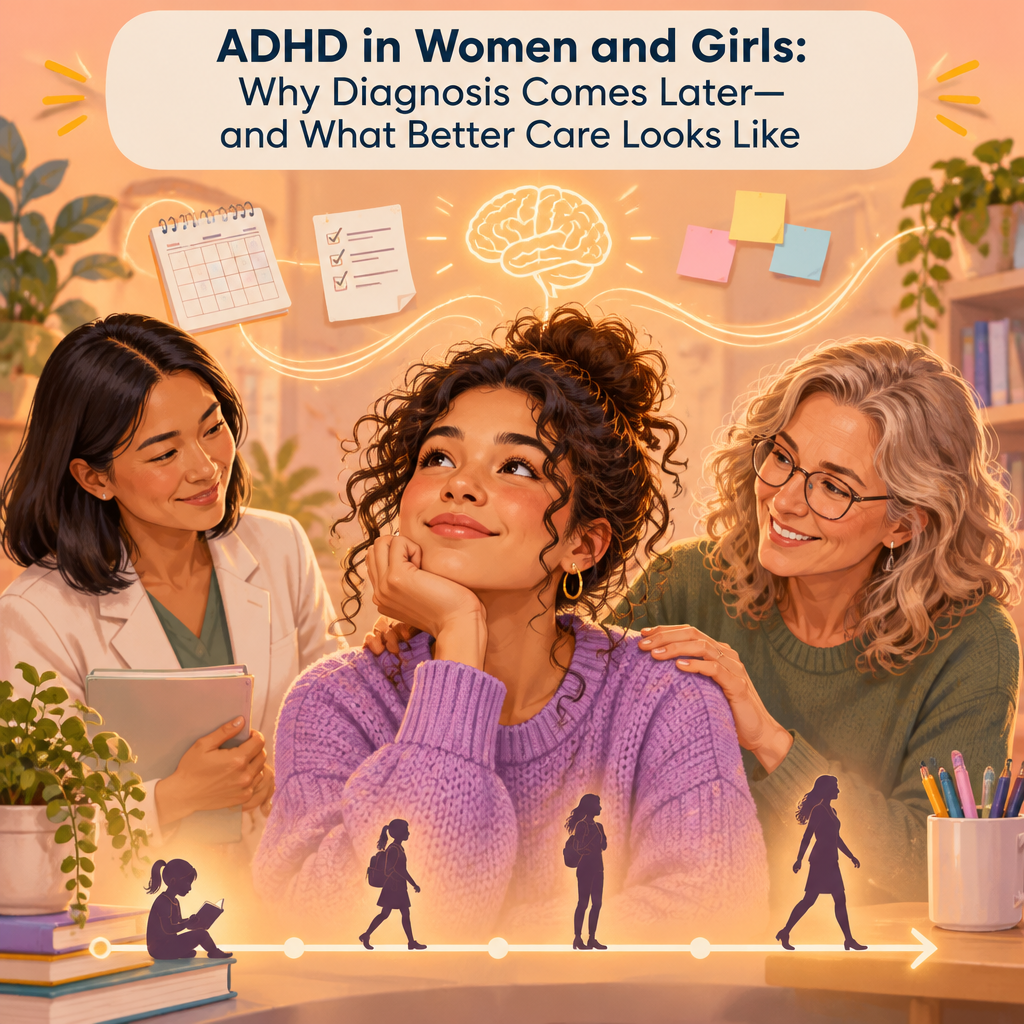
Why Better Recognition Matters
Recognition can change the question from “Why can’t I just get on with it?” to “What is making this hard, and what support fits?” That shift is not a cure, but it can reduce years of self-blame and point toward useful treatment, practical adjustments, and more realistic strategies. Frankly, advice to try harder is not much of a plan when the difficulty is persistent and affects several parts of life.
Late identification can have consequences. A student may spend hours on work that peers finish more quickly, miss deadlines despite caring deeply about the subject, or receive criticism for seeming disorganised. An adult may struggle to manage competing work, household, and caregiving demands. Repeated setbacks can affect confidence and contribute to stress. These outcomes are not inevitable, and they are not unique to ADHD, but they show why understanding a pattern matters beyond securing a label.
Anxiety, depression, sleep problems, trauma, learning differences, and ADHD can overlap. Anxiety may be the first concern a person brings to a clinician, or the most visible difficulty at a particular time. It can also occur alongside ADHD. Finding anxiety does not automatically exclude ADHD, and finding ADHD does not make anxiety unimportant. A good clinician asks about the sequence of symptoms, childhood development, current pressures, and the way each difficulty affects daily function. The point is not to force one explanation onto every experience.
The research has improved, but it has not kept pace equally with every group or question. More clinicians now recognise inattentive presentations and the possibility of adult diagnosis. Yet historical studies and clinical expectations often gave greater attention to disruptive behaviour and boys referred from school. The female ADHD consensus paper calls for better understanding across the lifespan, including co-occurring conditions and issues that can affect women at different ages. Evidence on hormones, pregnancy, and menopause is growing, but it is not a licence to explain every change in mood or concentration as ADHD.
There is also a measurement problem. Studies differ in who they recruit, which symptoms they measure, and how they define impairment or diagnostic delay. Women from different cultural, economic, and educational backgrounds may face different barriers to assessment; gender-diverse people may encounter additional gaps in research and services. Averages can signal a pattern, but they cannot describe every person. When I compare broad population findings with individual clinical questions, that distinction matters: a statistic can point toward a blind spot, not settle someone’s diagnosis.
Good recognition should lead to useful care, not just a name for the problem. Options may include medication, psychological support, skills-based strategies, workplace or educational adjustments, or a combination, depending on the person and local clinical guidance. The goal is not to make everyone equally productive. It is to reduce impairment and support a life that is workable and healthy. A person’s worth is not a performance score; caring for the body and mind means taking persistent difficulties seriously without treating a diagnosis as the whole identity.
A Step-by-Step Guide to Seeking an ADHD Assessment
- Write down concrete examples. Note what happens, how often it happens, and what it makes harder. “I am disorganised” is a starting point; “I miss bills even with reminders, and this has happened at home and at work for years” gives a clinician more useful detail. Include strengths and strategies that help, too. The aim is an accurate picture, not a case for the prosecution.
- Look across childhood and adulthood. ADHD is developmental, so an assessment usually asks whether relevant signs were present in childhood, even if no one named them at the time. School reports, old comments from teachers, family recollections, or examples from early jobs may help. Records are not always available, and memory is imperfect; lack of paperwork should not be treated as proof that symptoms never existed. The clinician weighs multiple sources of information.
- Describe effects in more than one setting. Consider home, school, work, friendships, finances, and daily tasks. A person may function well in a highly structured environment but struggle when they have to set their own schedule. Conversely, a difficult period in one setting might have another explanation. The NICE ADHD guideline sets out recommendations for assessment and management, including the importance of specialist evaluation rather than relying on a single score.
- Ask what the assessment includes. A proper evaluation generally involves a clinical interview and a developmental and psychiatric history; rating scales can add information, but they do not diagnose ADHD on their own. Depending on the situation, a clinician may ask for input from a partner, family member, or someone who knew the person as a child, with consent. They should also consider other conditions and factors, such as sleep, medication effects, mood, anxiety, and learning difficulties.
- Seek a qualified professional. Routes vary by country and health system. A primary care clinician may explain local referral options, while diagnosis and treatment may involve a psychiatrist, psychologist, paediatrician, or another professional with appropriate training and authority. Ask whether the clinician assesses adult ADHD and understands less obvious presentations in girls and women. If the first appointment leaves major questions unanswered, a second opinion may be reasonable.
- Discuss support after assessment. Treatment is individual. It may include medication, psychological therapies, coaching or skills support, educational or workplace adjustments, or changes to routines and task environments. Medication decisions require a qualified prescriber who can discuss benefits, risks, other health conditions, and follow-up. A diagnosis is not a command to take medication, and choosing not to use a particular treatment does not mean support is pointless.
- Review what is helping. Make a short list of goals that matter in ordinary life: fewer missed appointments, less time lost starting tasks, better sleep routines, or reduced conflict around household responsibilities. Revisit those goals with the clinician and adjust the plan where needed. I find this practical focus more useful than chasing a perfect productivity system. The test is whether daily life becomes more manageable, not whether someone resembles an idealised version of being organised.
Online checklists can help a person decide whether to ask for an assessment, but they are screening tools, not verdicts. Avoid turning a social-media list into a diagnosis or a reason to dismiss symptoms that do not match every item. Bring observations to a clinician and ask how they will distinguish ADHD from overlapping conditions. That is slower than a quick quiz, but it is more responsible.

Comparison: The Stereotype Versus Less-Recognised Presentations
This is not a comparison between two different disorders. ADHD is the topic; the “competitor” here is the narrow stereotype that often competes with a fuller clinical picture. The table contrasts what tends to get noticed quickly with patterns that may be easier to miss. Real people can show features from both columns, neither column is exclusive to a sex, and the table cannot diagnose anyone.
| Common stereotype that gets noticed | Less-recognised signs that may be reported by girls and women |
|---|
| Visible movement, calling out, or interrupting | Quiet inattention, losing track of instructions, or seeming to daydream |
| Behaviour that disrupts a classroom or meeting | Private effort to stay on task, with fatigue or unfinished work afterward |
| A clear, early referral from school | Difficulties explained away as forgetfulness, low motivation, stress, or anxiety |
| Symptoms obvious to other people | Internal restlessness, racing thoughts, or a sense of being overwhelmed |
| A child who struggles in most structured tasks | A child who performs well through high effort, family scaffolding, or strong routines |
| One visible problem treated as the whole story | ADHD considered alongside anxiety, depression, sleep, learning, and other factors |
The right-hand column is not a list of hidden symptoms that proves ADHD. These experiences also occur for many other reasons, and someone can have ADHD without describing them. The value of the comparison is that it reminds parents, teachers, and clinicians to ask about effort and impairment, not just disruption. A student may achieve good grades and still spend excessive time, need substantial help, or suffer significant stress to keep up.
The CDC and NICE provide broader guidance on symptoms and assessment. Their advice is more useful than a checklist of gendered traits because diagnosis depends on a persistent pattern, developmental history, impairment, and clinical judgement. A quiet presentation deserves attention when it causes real difficulty; a dramatic presentation deserves an equally careful assessment rather than assumptions.
The practical question is not whether a person behaves like the most familiar ADHD example. It is whether the pattern has been present over time, appears in relevant settings, and creates impairment that deserves support. That standard protects people who have been missed without turning every ordinary lapse into a medical condition.
Common Mistakes to Avoid
Assuming that good grades rule out ADHD. Grades tell only part of the story. A student may succeed through long hours, parental supervision, constant reminders, or a very strong interest in the subject. Ask what the achievement costs and whether the person can manage work consistently, rather than treating marks as a full measure of function.
Treating anxiety as proof against ADHD. Anxiety can be a separate condition, a consequence of repeatedly falling behind, or a co-occurring difficulty; a clinician should examine the individual history. The reverse mistake is just as common: blaming every anxious feeling on ADHD and overlooking a condition that needs its own care. Here’s the kicker: overlap makes a careful assessment more important, not less.
Relying on a single online test. A questionnaire can organise concerns and prompt a conversation. It cannot establish childhood onset, assess impairment across settings, or rule out other explanations. Be wary of anyone who promises a diagnosis from a few social-media posts or one brief score. Screening can be a doorway to assessment, not a substitute for it.
Expecting one treatment to fix everything. Medication helps some people and may not be suitable or sufficient for others. Practical adjustments, therapy, sleep support, and changes to task demands can matter as well. Treatment should be discussed with a qualified clinician and reviewed over time. Advice that says one method works for everyone is selling certainty the evidence does not provide.
Using a diagnosis as an identity or an insult. ADHD can explain patterns and guide support, but it does not sum up a person’s character, capacity, or future. At the same time, “everyone is a little ADHD” can trivialise a condition that causes substantial impairment. Respect both truths: symptoms exist on a spectrum of everyday experience, while a clinical diagnosis has specific criteria and real consequences.
Overstating what hormones explain. Some people report changes in attention or symptom burden around menstrual cycles, pregnancy, postpartum life, or menopause. Research is developing, and experiences vary. Those changes are worth discussing with a clinician, but they should not be used as a universal explanation or as a reason to adjust medication without professional guidance. Let’s be real: a plausible mechanism is not the same thing as settled evidence.
Frequently Asked Questions
Why is ADHD diagnosed later in women?
There is no single cause. Girls and women may show less disruptive symptoms, receive less attention from adults, or use strategies that conceal how much effort daily tasks require. Anxiety or depression may bring someone into care first, while older diagnostic expectations focused heavily on visible hyperactivity. These are patterns, not rules; an individual assessment must examine the person’s history and current impairment.
Can ADHD first appear in adulthood?
ADHD is a neurodevelopmental condition, so the symptoms do not simply begin in adulthood under diagnostic criteria. However, a person may only recognise the pattern or receive a diagnosis as an adult, especially when greater demands expose difficulties that childhood routines or family support had helped manage. A clinician will usually ask about childhood signs and consider other explanations for new problems.
Can someone have ADHD and anxiety at the same time?
Yes. ADHD and anxiety can occur together, and either can affect attention, sleep, and daily functioning. An assessment should consider whether symptoms began at different times, how they show up across settings, and what treatment or support each condition may need. One diagnosis should not automatically erase the other.
Is there a test that confirms ADHD in women?
There is no single blood test, brain scan, or questionnaire that confirms ADHD. Diagnosis rests on a qualified clinician’s assessment of symptoms, developmental history, impairment, and alternative or co-occurring explanations. Rating scales and information from other people can help, but they are parts of the evaluation rather than a stand-alone answer.
Final Thought
A woman who receives an ADHD diagnosis in adulthood has not necessarily missed an obvious sign. She may have spent years meeting expectations through effort that other people could not see, or she may have experienced difficulties that were attributed to something else. That history deserves curiosity rather than blame. Equally, a label should follow careful evaluation, not a stereotype or a quick internet quiz.
Research has moved forward, but it still needs better representation across age, background, gender, and life stage. Clinicians can improve recognition by asking about quiet inattention, internal restlessness, the work behind apparent success, and the person’s childhood as well as present-day demands. Researchers can improve the evidence by measuring more than visible behaviour and by studying how symptoms and support needs change over time.
The useful aim is neither to medicalise every struggle nor to dismiss patterns because they do not look familiar. It is to give people a fair assessment, explain what the evidence can and cannot say, and offer support matched to their needs. Bodies and minds deserve care without being reduced to output. When a person understands how they function and can get appropriate help, that is a solid place to start.