ADHD in Women: Why Diagnosis Takes Longer and What the Signs Can Look Like
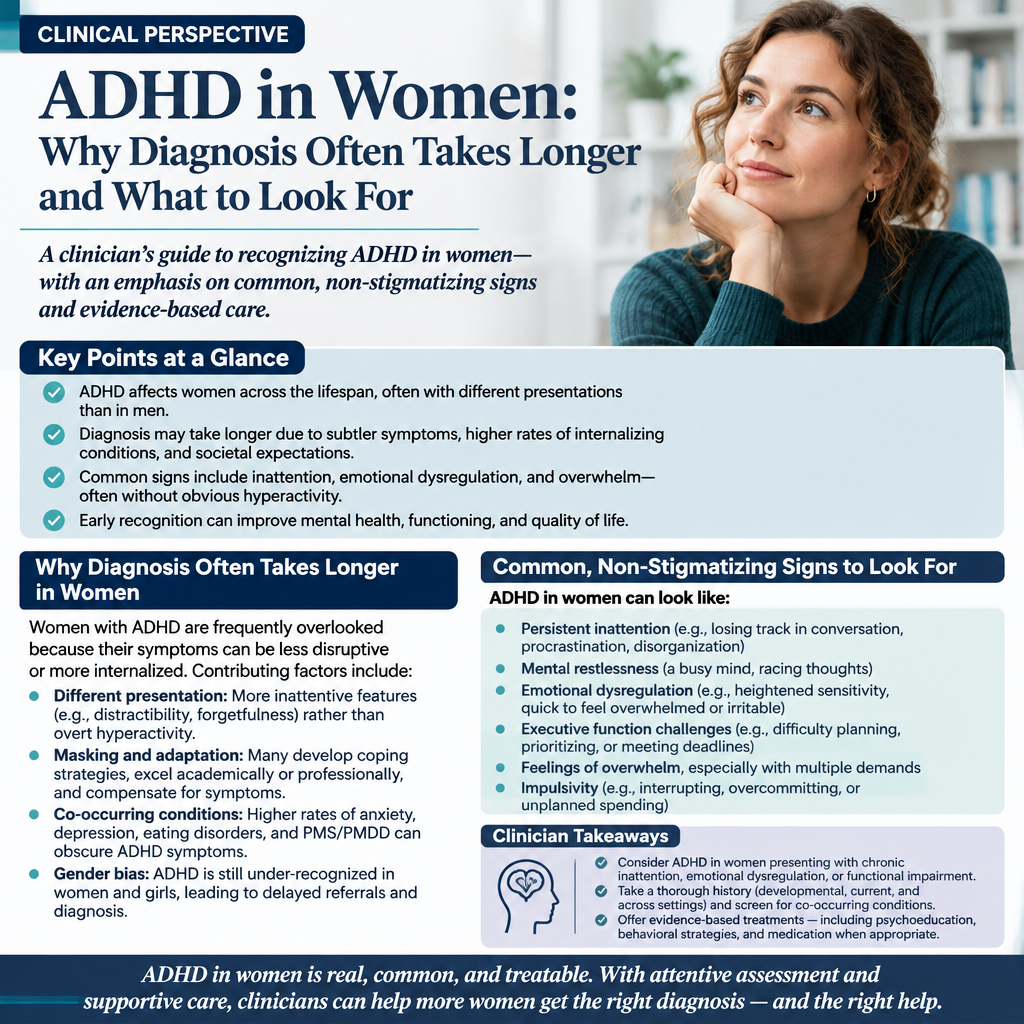
ADHD is a neurodevelopmental condition involving persistent patterns of inattention and/or hyperactivity-impulsivity that interfere with daily life. It is not simply poor focus or laziness. Girls and women can be missed when symptoms are less disruptive, masked through effort, or mistaken for anxiety; a careful assessment looks at a person’s lifelong pattern, not a stereotype.
Key Takeaways
- ADHD can go unrecognized in girls and women when their difficulties are less visible or they work hard to compensate.
- The core diagnostic criteria do not change by gender, but social expectations and coping strategies can affect what other people notice.
- A sound assessment considers childhood history, current impairment, other possible explanations, and co-occurring conditions.
- Medication is one possible treatment, not a requirement for everyone; practical, psychological, and environmental supports matter too.
In a conversation with journalist Maria Cohut, Prof. Davida Hartman, a Chartered Educational and Child Psychologist with the Psychological Society of Ireland, discussed why women may receive an ADHD identification later in life. The conversation reports an average delay of about five years compared with male peers; that is a broad estimate, not a timetable for any individual. Hartman also points to long waiting lists, cost, stereotypes, and distrust of women’s accounts of their own lives. Those are not minor administrative snags. They can shape who gets assessed at all.
What Is ADHD in Women?
Attention-deficit/hyperactivity disorder (ADHD) is a developmental condition associated with persistent inattention and/or hyperactive-impulsive symptoms. To meet diagnostic criteria, symptoms must begin during childhood, occur across relevant settings, and cause meaningful difficulty or impairment. People are not diagnosed because they occasionally lose their keys, feel restless, or dislike paperwork. The issue is a continuing pattern that affects everyday functioning.
ADHD is commonly described through three presentations: predominantly inattentive, predominantly hyperactive-impulsive, and combined. Those labels describe the symptoms most apparent at assessment; they do not define a person’s character or predict their potential. A woman whose main difficulties involve starting tasks, keeping track of details, or managing time may not match the familiar image of a child who cannot stay seated. That mismatch can delay recognition. It does not mean her difficulties are less real.
Examples can include losing track of conversations, forgetting appointments, struggling to begin tasks despite wanting to do them, feeling overwhelmed by several small demands, or repeatedly underestimating how long a task will take. Some people also experience restlessness, impulsive decisions, or difficulty pausing before responding. Executive-function difficulties are often part of the lived experience, but they are not a separate shortcut to diagnosis. A clinician needs to assess the full pattern, its history, and its impact.
Hartman argues that ADHD should not be reduced to a deficit of attention; for some people, attention is variable and can be hard to direct or sustain where needed. That framing can help explain why someone may focus intensely on an absorbing task yet struggle with routine administration. Still, a more generous description should not erase genuine disability. When I compare Hartman’s account with clinical guidance, the useful distinction is clear: describe the person accurately, then assess the difficulties that need support. The National Institute for Health and Care Excellence (NICE) ADHD guideline sets out the need for a comprehensive clinical assessment, rather than a diagnosis based on one symptom or questionnaire.
The criteria are not supposed to be different for women. What can differ is how symptoms are noticed, interpreted, and managed around other people. The review of ADHD in women and girls discusses how inattentive symptoms and overlapping difficulties can contribute to under-recognition. Frankly, expecting every person with ADHD to look like the loudest child in a classroom is a poor screening method.

Why Better Recognition Matters
Recognition can put a more accurate name to longstanding difficulties. That does not make every struggle an ADHD symptom, nor does it mean a diagnosis instantly fixes a person’s life. It can, however, replace a blanket judgement such as careless or unmotivated with questions that lead somewhere useful: What is hard to manage? When did it begin? What support changes the outcome?
Late identification can carry a cost. People who spend years compensating may feel exhausted by ordinary demands or blame themselves when the same problems keep returning. Anxiety and depression can occur alongside ADHD, and distress may also arise from trying to keep up without suitable support. Neither anxiety nor depression automatically proves that ADHD is present; neither should automatically close the door on assessing it. Clinicians need to consider both the full history and the possibility of more than one condition.
The interview reports that women with ADHD receive an identification, on average, about five years later than male peers. An average describes a group, not a promise about any one person, and the exact experience varies with access, age, setting, and the clinician’s expertise. Hartman describes waiting lists as substantial and private assessment as costly. If someone is struggling, those barriers can turn a reasonable request for help into a long exercise in persistence.
Research and training also need to catch up with the range of real lives. Hartman notes that systems and diagnostic expectations have often been shaped around hyperactive boys, while girls and women may be expected to sit still, be agreeable, and quietly handle competing demands. That does not establish that ADHD itself is a different condition by gender. It does show how expectations can hide symptoms or make a person’s account easier to dismiss. The expert consensus statement on females with ADHD calls for a lifespan approach to identification and care.
Masking deserves careful attention. People may copy others’ routines, over-prepare, or spend extra energy appearing organized, yet still experience significant strain. Hartman notes that research on masking in ADHD is still developing, with much of the discussion historically focused elsewhere. A clinician should ask what it costs to maintain an appearance of coping, not merely whether a person can get through a busy day. A body and mind deserve care, not a running scorecard of productivity.
Hormonal transitions are another active area of interest, not a settled explanation. Hartman describes research on ADHD and perimenopause as limited, including small studies; some findings suggest symptoms may change for some people, but they do not establish a universal pattern or prove that ADHD causes earlier perimenopause. Sleep disruption, mood changes, and concentration problems can have several causes. Bring a timeline to a clinician rather than assuming every change is hormonal or every change is ADHD.
Step-by-Step: Seeking an ADHD Assessment and Support
A good assessment is a process, not a quiz result. If you suspect ADHD, the following steps can make a clinical conversation more precise. They cannot replace a qualified professional’s evaluation.
- Write down patterns, not just bad days. Note recurring difficulties with attention, organization, time, task initiation, restlessness, or impulsive choices. Include examples from work, home, education, relationships, and everyday responsibilities. Record what helps and what makes things worse. Specific examples are more useful than a vague sense that something has always been off.
- Build a childhood timeline. ADHD symptoms must have been present during childhood, even if nobody recognized them at the time. Think about school reports, unfinished work, repeated reminders, lost belongings, daydreaming, emotional strain, or needing unusually intensive help to stay organized. If appropriate, ask a relative or someone who knew you then what they remember. Old records can help, but the absence of records does not, by itself, settle the question.
- Ask for a comprehensive assessment. Start with a primary-care clinician or a qualified ADHD service, depending on the system where you live. Ask who will conduct the assessment, what training they have, what information they need, how long the process may take, and what the cost will be. Under NICE guidance, diagnosis should follow a full assessment by an appropriately qualified specialist; rating scales can support that work but should not stand alone. See the NICE recommendations for ADHD diagnosis and management.
- Discuss overlapping concerns openly. Tell the clinician about anxiety, depression, sleep problems, trauma, physical health conditions, substance use, or other concerns that may affect attention and daily functioning. Some may coexist with ADHD; some may call for a different explanation or additional care. The point is not to win an argument for one label. It is to understand what is happening and what treatment or support fits.
- Make a practical support plan. Depending on the assessment and your needs, support may include education about ADHD, psychological care, adjustments at work or school, changes to routines and reminders, coaching, or medication. Medication decisions belong with a prescriber who can discuss expected benefits, possible adverse effects, and monitoring. The National Institute of Mental Health ADHD overview describes treatment as something that can involve medication, psychotherapy, education, or a combination, based on the person.
- Review what is actually helping. Choose a few concrete measures, such as arriving on time more often, completing a recurring task with less distress, or needing fewer last-minute rescue efforts. Revisit the plan with your clinician and adjust it when circumstances change. I find this more useful than demanding that someone become perfectly organized; the goal is a workable life, not a spotless planner.
If waiting lists are long, ask whether there is a cancellation list, a primary-care service that can offer interim support, or a local organization with reliable information. Keep notes on symptoms and barriers while you wait. Avoid providers who promise a diagnosis after a brief questionnaire or market a single product as a cure. A careful assessment may take effort, but careful is the point.
Comparison Table: ADHD in Women and the Familiar Stereotype
The contrast below is between commonly overlooked experiences and a popular stereotype—not between all women and all men. ADHD varies greatly within every group. Some girls and women are visibly hyperactive; some boys and men have primarily inattentive symptoms. The columns describe what observers may expect, not hard biological categories.
| What someone may notice | ADHD in women that can be missed | Familiar hyperactive-boy stereotype |
|---|
| Attention | Drifting during routine tasks, losing details, or appearing to listen while missing parts of the conversation | Obvious distractibility or difficulty staying with a classroom task |
| Activity level | Internal restlessness, fidgeting, or switching between tasks without completing them | Visible movement, calling out, or leaving a seat |
| Coping | Over-preparing, relying on reminders, or using substantial effort to appear organized | Difficulties are more readily noticed because they disrupt a class or household routine |
| Adult impact | Missed deadlines, household overload, forgotten plans, and fatigue from constant compensation | Early school or behavior concerns may prompt referral sooner |
| Common interpretation | Anxiety, disorganization, stress, or not trying hard enough | Hyperactivity or behavior problems |
Here’s the kicker: the visible behavior is not the whole clinical picture. A quiet child who daydreams may be struggling just as much as a child who disrupts a lesson, but adults may respond differently to the two. A woman may also learn ways to conceal or compensate for difficulties, which can make a quick observation misleading. The NIMH overview of ADHD describes ADHD as a condition that can affect attention, activity, and impulse control; it does not define it by one classroom stereotype.
Hartman’s account also puts social expectations in view. Girls and women may receive praise for being quiet, helpful, or compliant even when keeping up takes extraordinary effort. But researchers should not turn that observation into another rigid rule, such as assuming every woman masks or every inattentive presentation is hidden ADHD. Assessment has to follow the person’s developmental history and current impairment. When I analyze the comparison, its main value is not sorting people into columns; it is reminding observers to ask about less visible signs.
The table should not be used as a self-test. A few familiar traits do not establish a diagnosis, and not matching the stereotype does not rule one out. Look for persistent patterns across time and settings, then discuss them with a qualified clinician. That is less catchy than an online checklist. It is also more responsible.
Common Mistakes to Avoid
Mistake 1: Treating the stereotype as a diagnostic rule. ADHD does not require climbing furniture or disrupting a classroom. Inattention, internal restlessness, and difficulty managing everyday demands may be less conspicuous. Equally, being quiet or female does not mean someone has ADHD. Ask about the symptoms, their onset, and their effect instead of guessing from a personality style.
Mistake 2: Treating a screening score as a diagnosis. Rating scales can help organize information and identify areas for follow-up. They do not establish childhood onset, rule out other explanations, or show whether symptoms impair life across settings. Online quizzes are especially limited: they can prompt a useful conversation, but they cannot provide the full clinical assessment. The NICE guideline is clear that diagnosis requires a broader evaluation.
Mistake 3: Assuming anxiety explains everything—or that ADHD explains everything. Anxiety and depression may coexist with ADHD, follow years of strain, or arise for other reasons. Sleep problems, trauma, physical health issues, and other conditions can also affect focus and energy. A thoughtful clinician considers these possibilities without using one to dismiss the rest. Getting the label right matters because the support should fit the actual needs.
Mistake 4: Forgetting the childhood history. An adult may first seek help after work, family, or health demands increase, but ADHD does not suddenly begin in adulthood. The signs may have been overlooked, managed by family support, or mistaken for ordinary behavior. Hartman emphasizes the need for evidence that signs were present before age 12. That history can come from memories and records; it should be explored carefully, not reduced to whether a report card survives in a drawer.
Mistake 5: Treating medication as compulsory or as a cure-all. Some people benefit from medication; others may decline it, have contraindications, or prefer a different mix of supports. Medication is not a moral test and does not replace practical adjustments, education, or follow-up. Conversely, dismissing medication as unnecessary for everyone is just as sweeping. Decisions should be shared with a qualified prescriber, with benefits and risks monitored over time.
Mistake 6: Shaming ordinary support needs. Telling someone to try harder, stop forgetting, or care more rarely gives them a usable tool. Friends and family can be direct without being cruel: agree on reminders, put plans in a shared calendar, and discuss lateness or missed messages without turning each lapse into a verdict on character. Support is not permission to ignore the impact on others. It is a way to solve the problem without humiliation.
Mistake 7: Overstating what is known about hormones. Research on ADHD across perimenopause is emerging, and the evidence remains limited. Do not assume that hormonal treatment will resolve ADHD, that every new concentration problem signals ADHD, or that symptoms must worsen in the same way for everyone. Track changes and discuss them with a clinician who can consider the whole picture. Frankly, confident claims outrun the evidence here.
Frequently Asked Questions
Why is ADHD diagnosed later in many women?
Several factors can contribute: symptoms may be less disruptive, inattentive difficulties can be overlooked, and a person may compensate until demands increase. Stereotypes about ADHD, uneven professional awareness, cost, and long waits can add further delay. The interview with Prof. Davida Hartman reports an average gap of about five years compared with male peers, but averages do not predict an individual’s experience. Anxiety or depression may also become the first concern brought to a clinician. A full assessment should consider co-occurring conditions rather than treating them as automatic proof for or against ADHD.
Does ADHD present differently in women than in men?
The diagnostic criteria do not change by gender. People vary widely, and no presentation belongs exclusively to women or men. However, expectations about behavior, differences in referral patterns, and strategies such as over-preparing or concealing difficulties can change what others see. Some women report primarily inattentive difficulties; others have prominent hyperactivity or impulsivity. The sensible approach is to assess the person’s history and impairment rather than assume a gender-specific template.
How can an adult assessment confirm that ADHD began in childhood?
A specialist looks for a developmental history consistent with symptoms beginning during childhood, alongside current symptoms and meaningful impairment. The assessment may include a detailed interview, rating scales, school or work records, and information from someone who knows the person well, where available and appropriate. No single document is mandatory in every situation, and a questionnaire alone is not enough. The clinician also considers other conditions that may explain or accompany the symptoms.
Does everyone with ADHD need medication?
No. Treatment is individual. Medication may be helpful for some people, while others use psychological support, education, environmental adjustments, practical strategies, or a combination. A clinician and the person should weigh likely benefits, side effects, preferences, and health history, then review how the plan is working. Changes in concentration around perimenopause deserve discussion too, but current research is limited; do not start, stop, or change treatment based on a broad claim about hormones.
Final Thought
A late ADHD identification does not mean a person’s difficulties were imaginary, and it does not mean every past struggle had a single cause. It means the available explanation is being reconsidered against a fuller history. That distinction matters. A useful assessment makes room for uncertainty, checks childhood and adult patterns, and looks at overlapping mental and physical health concerns without reducing the person to a checklist.
For women who recognize themselves in these descriptions, the next step need not be a dramatic declaration or a hurried self-diagnosis. It can be a written list of examples, a conversation with a primary-care clinician, or a question about the qualifications and process of an assessment service. For friends, relatives, and colleagues, listening without shame is a practical form of support. Forgetting to text or arriving late can affect other people; addressing the effect is fair. Turning it into proof that someone does not care is not.
The goal is not to make every person fit a tidy standard of attention, punctuality, or output. It is to understand what helps someone function, participate, and feel less worn down by daily demands. Health is something to care for with balance and respect, not a contest in self-discipline. Better research and fairer access will not remove every difficulty, but they can make it less likely that women spend years being told to try harder when what they need is a careful assessment and useful support.