ADHD is a neurodevelopmental condition that can affect attention, impulse control, and activity levels. Women are often diagnosed later than men—not because...
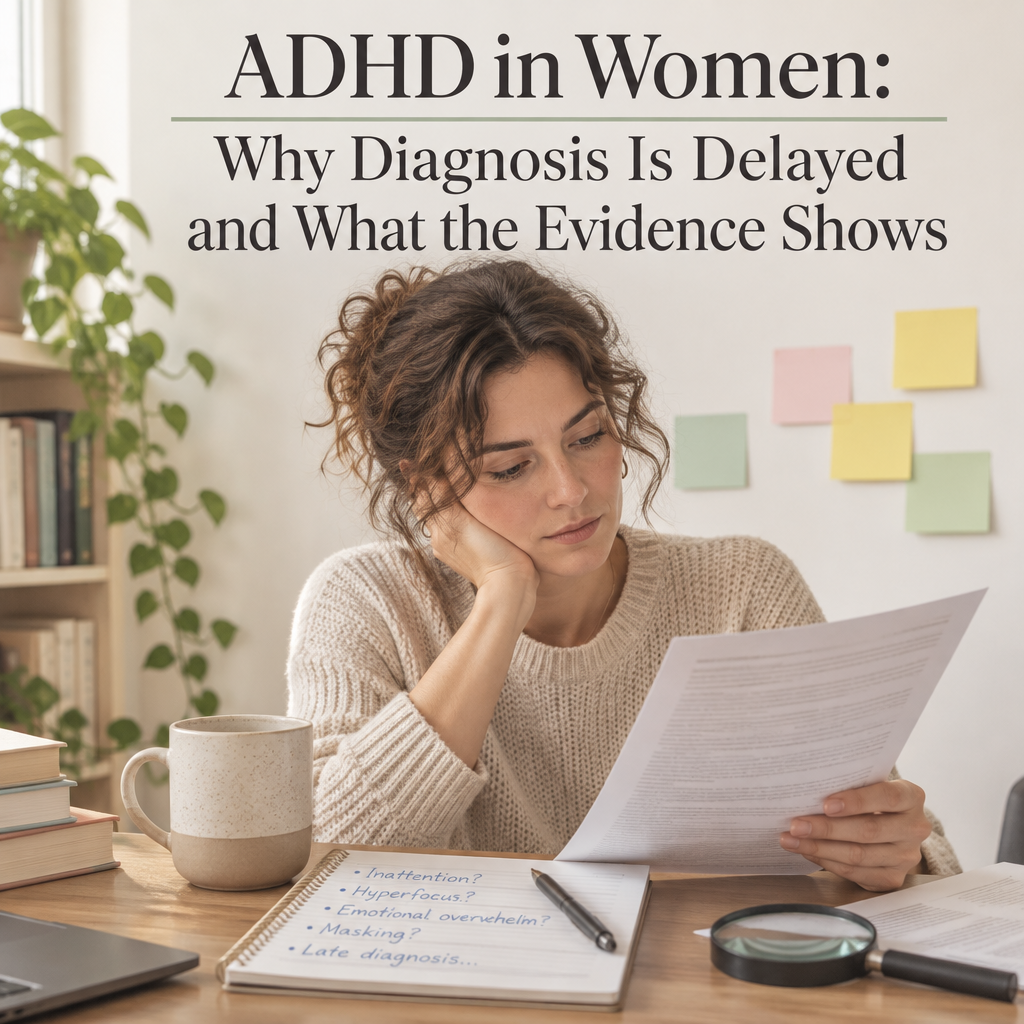
ADHD in Women: Why Diagnosis Is Delayed and What the Evidence Shows
ADHD is a neurodevelopmental condition that can affect attention, impulse control, and activity levels. Women are often diagnosed later than men—not because ADHD suddenly begins in adulthood, but because symptoms can be missed, mistaken for other conditions, or hidden by effortful coping. Understanding that gap can make assessment more accurate and support more humane.
In the Medical News Today In Conversation episode “ADHD in women: Breaking the stereotypes,” Prof. Davida Hartman, a Chartered Educational and Child Psychologist with the Psychological Society of Ireland, discussed why women can wait years for recognition. The episode cited an average diagnosis gap of about five years in some research, but that figure should not be treated as a universal rule: estimates vary by study, population, and health system.
The central issue is not that every woman experiences ADHD in one distinct way. It is that familiar expectations about what ADHD looks like have often favored conspicuous hyperactivity, while quieter or compensated difficulties draw less attention. Frankly, a person who appears organized from the outside may be paying for that appearance with exhaustion, missed sleep, or constant last-minute effort.
What Is ADHD in Women?
Attention-deficit/hyperactivity disorder (ADHD) is a neurodevelopmental condition associated with persistent patterns of inattention and/or hyperactivity and impulsivity that interfere with everyday functioning. The condition begins during childhood, although it may not be recognized until adolescence or adulthood. An adult diagnosis is not evidence that ADHD began in adulthood; it can mean that the signs were overlooked, misunderstood, or managed well enough to escape notice.
ADHD is not a measure of intelligence, character, care, or moral effort. A missed appointment does not prove that someone is selfish, and difficulty beginning a task does not prove laziness. The National Institute of Mental Health describes ADHD as a disorder that can affect attention, activity, and impulse control, while emphasizing that symptoms and their impact differ across people.
Diagnostic criteria do not create separate versions of ADHD for women and men. Still, social expectations can shape which behaviors adults notice, what children are encouraged to hide, and who gets referred for evaluation. Hartman emphasized that models built around a narrow, highly visible picture can fail people whose difficulties look less disruptive, including girls, women, and gender-diverse people.
When I review the distinction, the useful question is not whether someone matches a stereotype. It is whether longstanding symptoms are causing meaningful difficulty across parts of life, and whether a qualified clinician can establish a sound developmental picture. ADHD is real. So is the need to assess the whole person.
Why Better Understanding Matters
Correct recognition can replace years of moral judgment with a more useful explanation. That does not make every struggle an ADHD symptom, and it does not remove the need to build skills or repair harm. It can, however, help a person choose strategies that fit how their attention, planning, and emotional regulation actually work.
The cost of a missed diagnosis can show up in school, work, relationships, household tasks, and self-esteem. Someone may keep changing systems—planners, phone alerts, color-coded calendars—then decide they have failed when the systems collapse under stress. A diagnosis may help explain that pattern and point toward practical adjustments, but it is not a magic switch.
Misdiagnosis can also lead to support that addresses only part of the problem. Anxiety or depression may be diagnosed first because distress is visible, while the longer pattern of disorganization, forgetfulness, or inconsistent task completion remains unexamined. These conditions can also coexist with ADHD. The answer is not to dismiss anxiety as “just ADHD,” but to assess both carefully.
There is a human reason to take this seriously. People deserve care that respects their dignity rather than judging their worth by punctuality, tidy desks, or perfect recall. Treating health as something to steward responsibly means seeking sound information without demanding that everyone function in exactly the same way. Here’s the kicker: recognition matters most when it leads to support, not just a label.
How ADHD Can Present in Girls and Women
The core diagnostic features are not exclusive to one sex. What can differ is what other people see, what a person learns to conceal, and which difficulties become most costly as life changes. A girl who is not disrupting a classroom may still lose track of instructions, drift off during lessons, or need far more time than peers to finish routine work.
In women, possible signs include chronic forgetfulness, difficulty organizing tasks, losing items, struggling to estimate time, procrastinating despite good intentions, and feeling mentally restless. Some people describe a fast-moving inner monologue or a constant effort to keep several demands in view. These experiences are not diagnostic by themselves; they matter when they form a persistent pattern linked to impairment.
Masking is a useful term for efforts to conceal difficulties or meet expectations by spending extra energy. A student may copy classmates’ routines, stay up late to finish work, or rely on fear of failure to get started. At work, a person may appear capable because she overprepares, takes on too much, or compensates with rigid systems. The bill may arrive later as burnout, shame, or a sense that ordinary tasks require an unreasonable amount of effort.
Some women are first assessed after a major change in demands, such as leaving school, beginning a demanding job, caring for children, or facing a health transition. That does not mean those events caused ADHD. They may expose limitations in coping strategies that were previously sufficient. Research on ADHD and perimenopause is still developing; small studies and clinical reports do not yet justify firm claims that ADHD causes earlier perimenopause or that hormonal changes explain every increase in symptoms.
A careful assessment also includes trans and nonbinary people, rather than assuming that a gender stereotype fits everyone assigned female at birth. The expert consensus statement on females with ADHD discusses the need for a lifespan approach and better recognition of presentations that have been overlooked. Stereotypes are a poor screening tool. Individual history is better.
Why Can Diagnosis Take Longer?
There is no single cause. A mix of diagnostic habits, social expectations, access barriers, and the person’s own coping strategies can delay recognition. If a clinician expects ADHD to look like obvious disruption, a quiet child who daydreams, forgets homework, or struggles to start tasks may not trigger the same concern.
Historically, ADHD research and clinical examples have often centered on boys and men. That can leave professionals and families with a narrow reference point. Hartman described how a medical model can overlook experiences that do not match its familiar picture, and she also pointed to the invalidation of women’s reports when difficulties are attributed only to anxiety or “women’s issues.” That is a fair concern, though no single explanation accounts for every missed diagnosis.
Referral pathways matter. A teacher may notice a child who interrupts a lesson before noticing one who quietly falls behind. A family may interpret forgetfulness as carelessness, while the person herself may assume everyone else finds daily life just as tiring. If symptoms are compensated for by a supportive parent, a structured school, or exceptional effort, the impairment can remain less visible until demands increase.
ADHD can also overlap with anxiety, depression, trauma-related symptoms, sleep problems, learning differences, and other health conditions. A clinician who stops at the first plausible explanation may miss a co-occurring condition or the underlying developmental pattern. The CDC’s ADHD diagnosis guidance notes that there is no single test for ADHD and that other conditions can produce similar symptoms.
Finally, getting an assessment may take money, time, specialist availability, and the ability to explain a complicated history. Some people face additional barriers related to race, language, disability, or limited access to health care. The episode’s five-year estimate is a useful prompt to examine delays, not a stopwatch that predicts every woman’s experience. The pattern is more important than the headline number.
A Step-by-Step Guide to Seeking an Assessment
A diagnosis should come from a qualified health professional with experience assessing ADHD, not from a social-media checklist. Screening tools can help someone decide whether to ask for help, but a positive score is not a diagnosis. The NICE ADHD guideline sets out recommendations for assessment and care, including the importance of a comprehensive clinical evaluation.
- Write down current difficulties. Note examples involving work, study, home responsibilities, relationships, time management, or emotional regulation. Describe what happens and how often, rather than relying on labels such as “bad at organizing.” Specific examples are more useful than a long list of traits.
- Build a developmental history. ADHD symptoms must have been present in childhood, even if they were not recognized or formally diagnosed then. Collect school reports, old evaluations, or recollections from relatives if available. Do not assume that missing documents make assessment impossible; clinicians can consider multiple sources and be clear about uncertainty.
- Describe the cost of coping. Explain what it takes to meet ordinary demands: late nights, repeated reminders, overpreparation, missed meals, or depending on another person to manage appointments. Outward success does not automatically mean there is no impairment. The effort and consequences matter too.
- Ask how the clinician evaluates alternatives. A sound assessment considers ADHD symptoms and their effects in more than one setting, while also considering other possible explanations and conditions that may occur alongside ADHD. Depending on the case, the clinician may ask about sleep, mood, anxiety, learning, trauma, physical health, and substance use. A good process does not force every detail into one diagnosis.
- Discuss what happens next. If ADHD is confirmed, ask about treatment options, expected benefits, possible side effects, and how progress will be reviewed. If it is not confirmed, ask what explanation or support the clinician recommends. A careful assessment should leave the person with a practical plan, not simply a verdict.
I put more weight on a careful timeline than on a dramatic “aha” moment. Hartman stressed that assessment should be rigorous and include evidence of symptoms before age 12; that history can be reconstructed from multiple sources, although the details and local diagnostic standards vary. No one should invent childhood symptoms to satisfy a checklist. Uncertainty should be documented honestly.
Medication is one possible part of care, not a universal requirement. The American Academy of Pediatrics clinical practice guideline covers diagnosis and treatment in children and adolescents; adult care should likewise be tailored to the person and managed by an appropriate clinician. Some people benefit from medication, while others choose different supports or combine approaches. Do not start, stop, or change prescribed treatment without consulting the prescriber.

ADHD and Anxiety: A Useful Comparison, Not a Shortcut
Anxiety is a common alternative explanation considered during an ADHD assessment, but the two are not competing teams where one must win. They can occur together, and they share features such as poor concentration, restlessness, and difficulty sleeping. The table highlights broad patterns, not a self-diagnosis test.
| Feature | ADHD | Anxiety |
|---|
| Central pattern | Persistent inattention and/or hyperactivity-impulsivity that affects functioning | Excessive worry, fear, or tension that is difficult to control |
| Developmental timing | Symptoms begin in childhood, even if recognized much later | May begin at different ages; timing depends on the person and the condition |
| Common attention difficulty | Attention may drift, shift, or be hard to direct, including during low-interest tasks | Attention may be pulled toward worries, threats, or anticipated problems |
| What can look similar | Restlessness, forgetfulness, incomplete tasks, and sleep disruption | Restlessness, forgetfulness, incomplete tasks, and sleep disruption |
| Can both be present? | Yes | Yes |
| What assessment needs | Developmental history, symptoms, impairment, and other explanations | Symptom history, triggers, impairment, and other explanations |
The key distinction is often the pattern over time, not one behavior on one difficult day. Someone with ADHD may also worry because repeated missed deadlines have consequences; someone with anxiety may struggle to focus because worry occupies attention. Both processes can reinforce each other. “It’s just anxiety” can be as careless as “it’s all ADHD.”
Clinicians use interviews, rating scales, history, and clinical judgment rather than a single blood test or brain scan. The CDC explains that ADHD has no single diagnostic test, so the assessment needs to examine symptoms, impairment, and other possible causes. This is why a short online quiz can be a prompt to seek advice, not proof. The comparison helps frame questions. It cannot settle the diagnosis.
Common Mistakes to Avoid
Mistake one: treating visible hyperactivity as the whole condition. Fidgeting and interrupting can be clues, but they are not the only clues. Inattention, poor time awareness, and difficulty completing tasks may be less noticeable to adults around a child. If a person is quiet, that does not prove attention is steady.
Mistake two: assuming good grades or a successful career rule ADHD out. Achievement is relevant, but it does not reveal the effort, distress, or support involved. Someone may meet deadlines only by working through the night or rely on a partner to track every appointment. Ask what the accomplishment costs. Frankly, “she seems fine” is not a clinical assessment.
Mistake three: blaming every difficulty on ADHD. Forgetfulness and poor concentration can have many causes, including sleep loss, anxiety, depression, trauma, medication effects, and physical health problems. ADHD can coexist with these conditions, but careful assessment matters. A label should sharpen the questions, not end them.
Mistake four: assuming medication is either a cure-all or a failure. Hartman’s answer was clear: medication can genuinely help some people, but it is not the entire story and will not suit everyone. A prescriber can discuss options, likely benefits, side effects, and follow-up. Practical supports—such as reminders, clearer task steps, a quieter workspace, or therapy—may also be useful, depending on the person.
Mistake five: treating forgetfulness as proof that someone does not care. A missed birthday or unanswered message can hurt, and the effect on a relationship still deserves attention. But intent cannot always be inferred from a lapse. Agreeing on reminders, communication preferences, and repair plans is often more useful than turning a memory failure into a verdict on character. Compassion is not the same as pretending there is no impact.
Mistake six: expecting an adult to produce perfect childhood records. School reports and family recollections can help, but not everyone has access to them. The clinician should document the evidence available, consider its limits, and explain how uncertainty affects the assessment. Guesswork helps nobody.
Frequently Asked Questions
Can ADHD first develop in adulthood?
ADHD is a neurodevelopmental condition, so symptoms must have been present during childhood even if no one identified them then. Adult diagnosis often means the pattern was recognized later, perhaps after school structure or family support changed. A clinician should examine the history rather than assume that current difficulties prove childhood ADHD.
Does ADHD look different in women?
The diagnostic features are not exclusive to women, but symptoms may be less visible or interpreted differently because of expectations about behavior. Some women describe more internal restlessness, masking, or inattentive difficulties, but there is no single “female ADHD” profile. Assessment should focus on the individual’s pattern and impairment.
Can perimenopause make ADHD symptoms worse?
Some emerging, relatively small studies and clinical reports suggest that hormonal changes may affect symptoms for some people. Evidence is not strong enough to make a universal claim, and changes in concentration or mood can have several causes. Discuss new or worsening symptoms with a health professional rather than changing medication on your own.
Does everyone with ADHD need medication?
No. Medication can be helpful for some people, while others may prefer or need different forms of support, and some benefit from a combination. Decisions should consider symptoms, health history, preferences, possible side effects, and treatment goals. A clinician can help review options; no single plan suits everyone.
Final Thought
A late diagnosis does not erase the years someone spent trying to make sense of daily struggles. Nor does a diagnosis explain every part of a person’s life. It can offer a more accurate framework for understanding recurring patterns, finding suitable supports, and replacing needless self-blame with informed action.
The strongest response is neither to dismiss women’s experiences nor to diagnose every familiar difficulty from a list online. It is to listen carefully, ask about childhood and current functioning, check for overlapping conditions, and take the limits of the evidence seriously. When I weigh the central point from Hartman’s discussion, it is this: the person’s account deserves attention, and the assessment deserves rigor.
Support can be ordinary and practical: clearer expectations, agreed reminders, a less distracting setting, flexible ways to complete work, or treatment chosen with a clinician. Friends and family can avoid treating a forgotten name or delayed message as automatic proof of indifference, while still talking honestly about the effects. Help should reduce unnecessary friction, not demand that someone hide every difference.
Bodies and minds deserve respect, and health is worth stewarding with patience rather than shame. That does not mean lowering every expectation; it means matching expectations and support to the real person in front of us. A more accurate understanding of ADHD in women begins there—with curiosity, good evidence, and care that does not confuse a person’s struggles with their worth.