AI-Assisted Colonoscopy: What Polyp-Detection Software Can—and Can’t—Do
Artificial intelligence can help colonoscopists spot polyps, but it does not diagnose cancer, replace a clinician, or make colonoscopy infallible. In trials, computer-aided detection has often increased the number of adenomas found during an exam. The practical question is whether finding more lesions improves outcomes enough to justify the extra alerts, costs, and follow-up.
What Is AI-Assisted Colonoscopy?
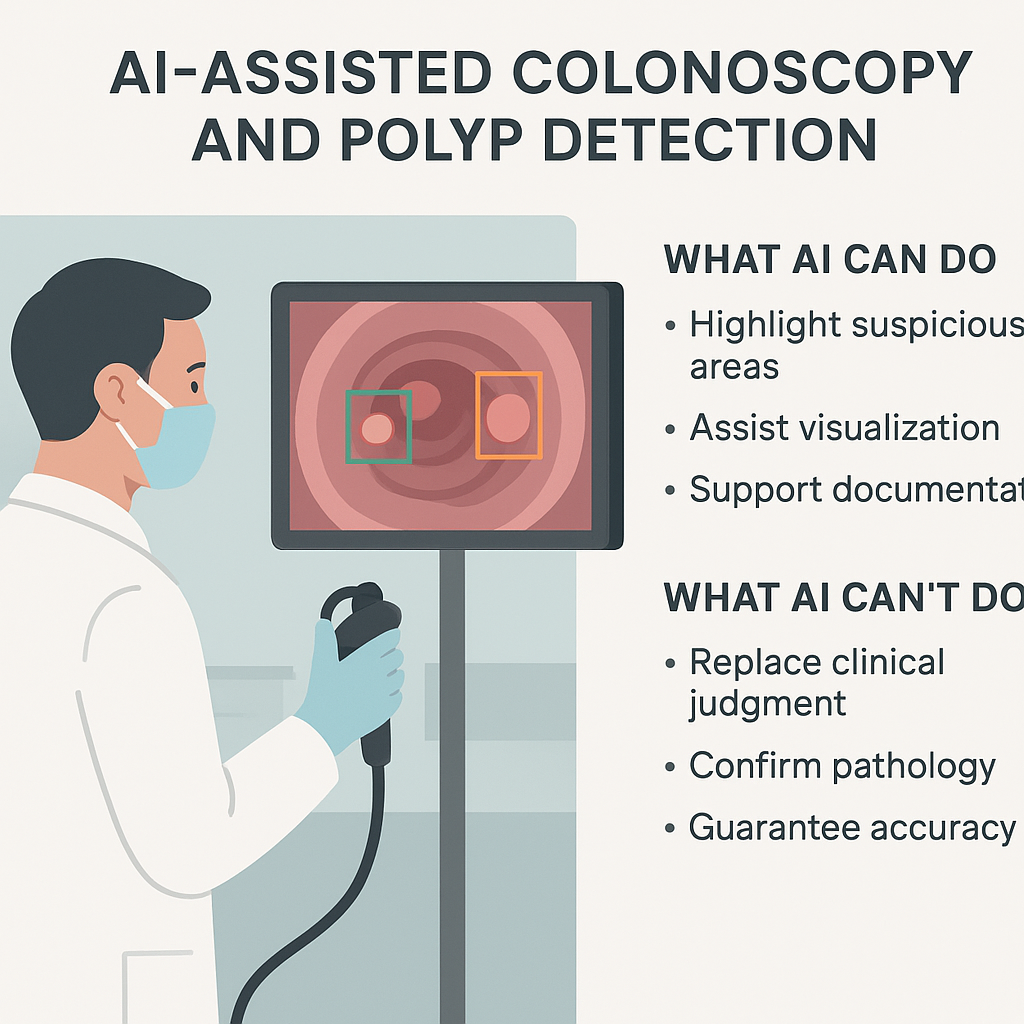
A colonoscopy uses a flexible camera to inspect the lining of the large intestine. During the procedure, the endoscopist looks for abnormal growths, including adenomas—some of which can become colorectal cancer over time—and removes or samples lesions when appropriate. AI-assisted colonoscopy adds software that analyzes the live video feed and draws attention to areas that resemble polyps.
The common term is computer-aided detection, often shortened to CADe. The system processes images as they appear, then may place a box, color marker, or other visual cue over a suspected lesion. It does not reach into the bowel, remove a polyp, or independently determine whether tissue is benign or dangerous. Those decisions remain with the clinical team, usually with pathology helping establish what a removed lesion was.
The Polish trial described in the supplied passage used a practical design: four endoscopy centers used the technology on some days and not on others. That sort of comparison can help researchers estimate what changes when the software is available in routine clinical work. It is different from asking whether a computer can identify a polyp in a selected set of still images. Real procedures include movement, fluid, folds, variable preparation, and the steady pressure of examining the entire colon.
Frankly, “AI found it” is too loose a description. The software raises an alert; a clinician decides whether the alert points to a real lesion and what to do next. The tool is closer to a second pair of eyes than an autonomous doctor, and that distinction matters whenever people discuss medical technology.
Clinical trials have generally measured outcomes such as adenoma detection rate (ADR), the proportion of colonoscopies in which at least one adenoma is found. ADR is a useful quality measure: research has associated higher endoscopist ADR with lower risk of colorectal cancer after colonoscopy. But ADR is not a direct count of cancers prevented, and a better score does not automatically prove that a particular device improves long-term health. The New England Journal of Medicine trial of AI-aided colonoscopy is one example of a randomized study examining detection outcomes.
Core Benefits and Importance
The clearest potential benefit is straightforward: a real-time alert may draw attention to a small or easily overlooked lesion. Colonoscopy is a visual examination, and even skilled clinicians can miss some polyps. Fatigue, camera angle, bowel preparation, folds, and the pace of withdrawal can all affect what is seen. A second observer that never blinks may help—but it still depends on the quality of the video and the clinician’s attention.
Research on CADe systems has often found an increase in adenoma detection, especially for small lesions. That can matter because some adenomas are precursors to colorectal cancer. The NEJM trial reported improved adenoma detection with AI assistance in its study setting. Other trials and reviews have examined similar questions, but results can differ by device, study design, patient group, and the experience of the endoscopist. “AI works” is not a careful enough summary; the more useful question is what a specific system changes, for whom, and at what cost.
Possible advantages include:
- More visual prompts: An alert can call attention to a region that deserves a closer look.
- Support for consistency: A second observer may help reduce variation between exams, though software cannot make every procedure equally careful.
- Potential quality improvement: If extra alerts lead to meaningful detection and appropriate removal, the exam may identify lesions that would otherwise be missed.
- A measurable intervention: Researchers can compare procedures with and without CADe and track detection rates, procedure times, and other outcomes.
Here’s the kicker: finding more polyps is not automatically the same as helping more patients. A system may increase removal of diminutive lesions—tiny growths that are often low risk—without demonstrating that it reduces cancer incidence or mortality. Every removed lesion can mean pathology work, cost, and sometimes extra surveillance. Follow-up colonoscopies are generally safe, but they are not entirely free of risk or burden.
The U.S. Preventive Services Task Force colorectal cancer screening recommendation also puts colonoscopy in context: it is one of several recommended screening strategies for eligible adults, not a universal requirement for every person in every circumstance. Screening decisions depend on age, risk, history, local guidance, and discussion with a health professional.
The point is not to distrust technology on principle. It is to judge it by patient-relevant outcomes, not a flashy screen or a larger tally. A person’s health deserves careful stewardship, and that includes sensible use of both medical tools and the follow-up they trigger.
Step-by-Step: How to Think About an AI-Assisted Colonoscopy
Patients do not need to become software auditors before a colonoscopy. They do benefit from understanding the decisions around screening, preparation, procedure quality, and follow-up. I focus on the parts that influence care rather than the marketing around a device.
- Confirm why screening or examination is being considered. Screening is intended for people without symptoms; a diagnostic colonoscopy may be recommended because of symptoms, a positive stool test, prior findings, or a personal or family history. These situations are not interchangeable. Ask the clinician what the exam is meant to answer, and whether your age and risk profile fit current recommendations. The National Cancer Institute’s colorectal cancer screening fact sheet outlines the role and limits of screening tests.
- Ask about the center’s process, not just its software. You can ask whether computer-aided detection is used, how the endoscopist reviews alerts, and whether the center tracks standard quality measures. The software label alone tells you little. A careful examination, appropriate training, and reliable documentation are still central.
- Follow bowel-preparation instructions closely. This is not glamorous advice, but it matters. Poor preparation can obscure the bowel lining and make the exam less effective, whether or not AI is present. If the instructions are unclear, contact the care team rather than improvising. Do not change prescribed medicines or preparation plans without clinical advice.
- Understand what happens during the procedure. The camera provides the view. The software may flag a suspicious pattern, and the endoscopist decides whether it is a polyp, an artifact, or something else. If a lesion is removed or sampled, the tissue may be sent for analysis. CADe is not the same as computer-aided diagnosis (CADx), which may attempt to characterize a lesion; neither term means a machine has made a final diagnosis for you.
- Get the report and the follow-up plan. Ask what was found, whether tissue was removed, when pathology results will be available, and when the next screening or surveillance exam is advised. The interval depends on findings and individual history; there is no single schedule that suits everyone. If the report is confusing, ask the clinician to explain it in ordinary language.
- Treat alerts as prompts, not verdicts. During the procedure, the clinician has to judge whether a signal corresponds to an actual lesion. If the system produces a false alert, the doctor can disregard it. If there is no alert, that does not prove the colon is free of abnormal tissue. That is why a high-quality examination cannot be reduced to a device’s detection counter.
The basics remain stubbornly important. Preparation, a complete exam, careful withdrawal, appropriate removal, pathology, and follow-up each play a part. Technology can support a good process; it cannot rescue a poor one by magic.
AI-Assisted vs. Conventional Colonoscopy
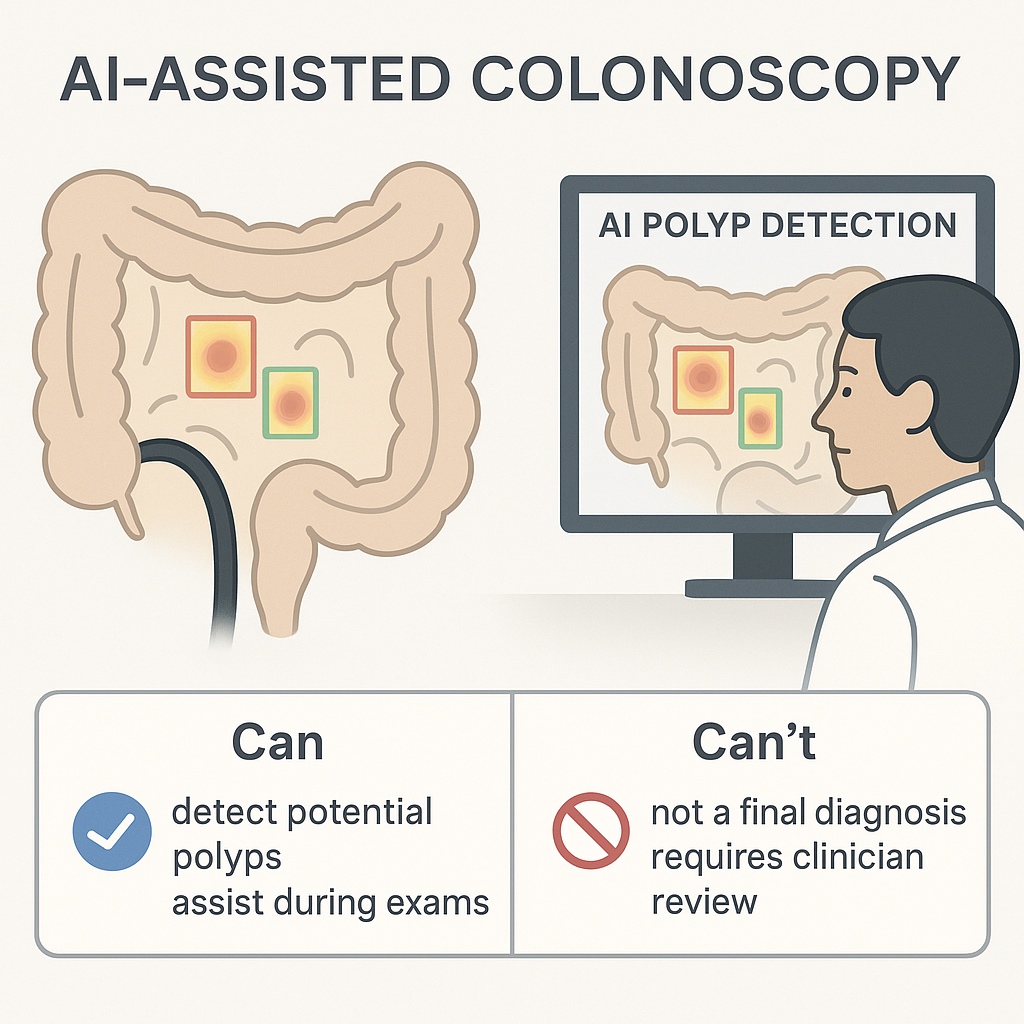
The comparison is not “computer versus doctor.” Both approaches involve a clinician performing colonoscopy. The difference is whether a computer-aided detection system analyzes the live video and provides visual prompts. The table reflects what the technology is designed to do and what studies commonly measure—not a guarantee of results at every clinic.
| Feature | AI-assisted colonoscopy | Conventional colonoscopy without CADe |
|---|
| Who performs the exam? | A trained endoscopist, supported by software alerts | A trained endoscopist using the video image |
| What the computer does | Flags image regions that resemble polyps | No real-time CADe alerts are shown |
| Who decides whether a lesion is real? | The endoscopist | The endoscopist |
| Does the approach remove tissue by itself? | No; the clinician performs any biopsy or removal | No; the clinician performs any biopsy or removal |
| Common research outcome | Adenoma or polyp detection, plus procedure measures | The same outcomes provide a comparison group |
| Potential drawback | False alerts, extra inspection or removal, added cost | Lesions can still be missed by human visual inspection |
| Proven patient-outcome benefit | Better detection has been reported in trials; long-term benefit needs outcome evidence | Established screening method with evidence and guideline support |
AI does not replace colonoscopy; it modifies the visual workflow. A high detection rate is encouraging, but patients should be cautious about claims that leap from “more lesions found” to “cancer prevented.” Those are separate conclusions and require different evidence. The USPSTF recommendation summarizes screening strategies and evidence for eligible populations, while clinical trials help assess what a specific assistance tool adds to the procedure.
Common Mistakes to Avoid
The most common mistake is treating an AI alert as a diagnosis. It is not. Image recognition identifies patterns that resemble items in the data used to train or test a model. The alert may correspond to a polyp, but it may also reflect a fold, stool, bubbles, glare, or movement. The endoscopist must inspect the area and make a clinical judgment.
Another mistake is assuming that more detection always means better care. More adenomas found can be a valuable signal, especially if lesions with meaningful risk are identified and removed. But a higher count can also include small lesions that would never cause harm during a patient’s lifetime. That does not mean such lesions should be ignored; it means results need careful interpretation, with pathology and guideline-based follow-up rather than a reflexive “more is always better.”
People also confuse detection with diagnosis. CADe systems are designed to highlight possible targets. A separate class of tools may try to estimate the nature of a lesion, but image-based predictions are not a substitute for the clinician’s assessment or pathology when tissue is removed. The FDA overview of software as a medical device explains the broader regulatory category; a product’s regulatory status and intended use should be considered before making claims about what it can do.
A fourth error is treating a study result as a promise for every patient. Trial results depend on who was enrolled, the equipment used, the clinicians’ experience, the comparison method, and how outcomes were measured. A multicenter study can improve the practical relevance of evidence, but no trial removes the need to ask whether the results apply to a particular clinic or individual.
Finally, do not let a device name distract from procedure fundamentals. An AI system cannot make inadequate bowel preparation disappear. It cannot guarantee a complete examination, interpret every symptom, or ensure that someone receives pathology results and appropriate follow-up. A polished display is not the same thing as a robust care pathway.
Frankly, technology marketing often outruns clinical evidence. Be wary of claims that imply AI never misses a polyp, detects every cancer, or makes the endoscopist unnecessary. No visual detection system is perfect. The sensible stance is neither blind enthusiasm nor blanket rejection: ask what the tool is intended to do, what outcome has been demonstrated, and who remains accountable for decisions.
Frequently Asked Questions
Does AI-assisted colonoscopy find more polyps?
In several randomized trials, computer-aided detection increased adenoma or polyp detection compared with colonoscopy without the tool. The size of the effect varies across studies and systems. More detection is a measurable finding, but it does not by itself establish that the device reduces colorectal cancer or death. Ask about the specific system and the evidence relevant to the clinic using it.
Can AI detect colon cancer during a colonoscopy?
CADe tools generally flag visual patterns that may be polyps; they are not a standalone cancer diagnosis. A clinician evaluates the area and may remove or sample tissue. A pathologist may then examine a specimen. Some software may be designed to help characterize lesions, but that is a distinct function and should not be confused with an independent medical diagnosis.
Does AI replace the endoscopist?
No. The endoscopist performs the procedure, interprets the alerts, decides whether tissue should be removed, and makes or communicates the care plan. AI can support visual attention, but the clinician remains responsible for the examination and decisions. The software also cannot replace preparation, pathology, or follow-up.
Should I choose a clinic because it uses colonoscopy AI?
Not on that fact alone. It is reasonable to ask whether the clinic uses CADe and how it fits into the procedure, but also ask about preparation instructions, quality monitoring, how findings are reported, and how follow-up is arranged. Your own risk factors and screening choices should be discussed with a qualified health professional. Screening recommendations can change and vary with age, history, and local guidance.
A useful medical tool earns trust by improving care, not by making the screen look busy. AI-assisted colonoscopy is promising because an extra set of visual prompts may help clinicians find lesions, and trials have reported higher detection with some systems. That is a meaningful step, but it is not the finish line: we still need careful evidence on patient outcomes, costs, false alerts, and the consequences of finding and removing additional lesions.
Patients should not be asked to choose between human skill and software as though one must defeat the other. The sensible arrangement is a competent clinician, a well-prepared patient, a reliable examination, and technology used within its limits. Ask clear questions, get the findings explained, and follow the recommended plan. Health is a gift worth caring for with sound judgment—not with hype, and not with needless fear.