Health Care Financial Resilience: Better Care, Better Outcomes, and Lower Total Costs
Health care financial resilience does not come from cutting every line item. It comes from delivering appropriate care at the right time, in a form people can use, while preventing avoidable illness and expensive complications. That means looking beyond hospital budgets to the conditions that shape health: housing, food access, transportation, income, safety, and trust.
What Is Health Care Financial Resilience?
Health care financial resilience is an organization’s ability to maintain access to safe, effective, and meaningful care while adapting to changes in revenue, costs, workforce capacity, and community needs. It is not the same as having a large cash reserve, nor does it mean squeezing every service until the budget looks tidy. Resilience asks whether a health system can continue to serve people well when circumstances change.
At a recent health care conference, leaders framed the challenge in a useful way: rather than asking only how to save money, they asked how to provide the right care, at the right time, in the way that matters to patients—so outcomes improve and total costs decline. That distinction matters. A lower bill for one department may simply become a higher bill for another, or a new burden for a patient who cannot afford the next step in treatment.
I find that financial discussions often treat health as if it were produced inside a clinic alone. It isn’t. Clinicians can prescribe medication, but a patient may lack transport to collect it, a safe place to store it, or enough money to pay the copay. A discharge plan can be medically sound on paper and still fail if the patient has no reliable support at home. The health care system does not control every condition affecting health, but it can recognize those conditions and respond more intelligently.
The term social drivers of health commonly describes the circumstances in which people are born, grow, live, work, and age. Structural drivers include the policies, institutions, and patterns of power that shape those circumstances—such as housing policy, labor conditions, education access, and the distribution of health services. The World Health Organization explains how these conditions influence health differences between groups. See the WHO overview of social determinants of health.
Frankly, the phrase “address social needs” can sound like a promise to fix everything. A clinic cannot solve poverty alone. It can, however, ask about barriers with care, connect people to useful services, and design treatment that accounts for a person’s real circumstances. That is a more practical definition of patient-centered care—and a more honest foundation for financial planning.
Why Financial Resilience Matters
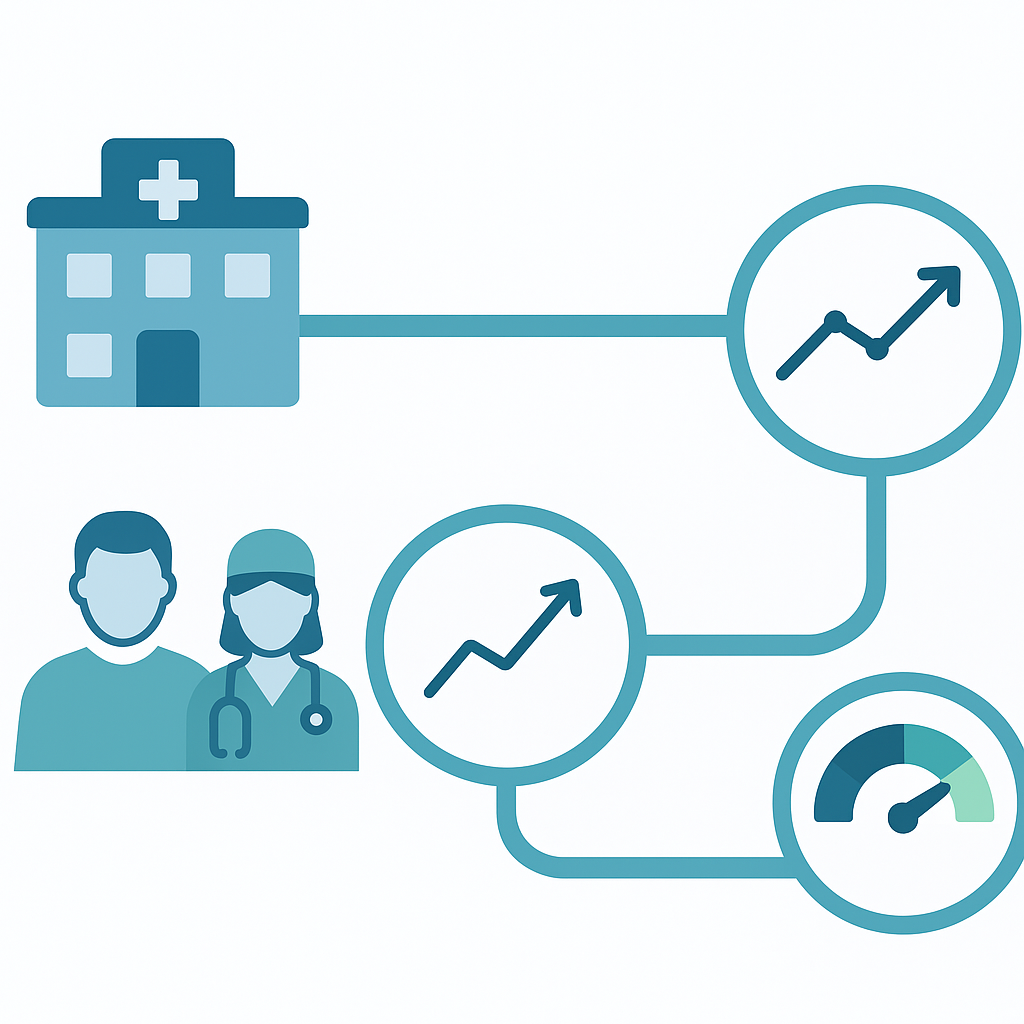
Financial stability matters because care requires people, facilities, equipment, time, and reliable operating funds. When an organization is financially fragile, it may struggle to retain staff, maintain services, invest in prevention, or absorb sudden changes in demand. Yet financial health is not a goal that can be judged apart from clinical quality and access. A system that balances its books by leaving important needs unmet has not necessarily become resilient; it may have moved the cost elsewhere.
The benefits of a broader approach include:
- More timely care. Early access to primary care and follow-up can help identify problems before they become emergencies. The effect depends on the condition, the service, and whether patients can actually reach the care.
- Fewer avoidable complications. Medication support, chronic disease management, and clear transitions between care settings may reduce preventable harm and unnecessary use.
- Better patient experience. Care that accounts for language, transport, disability, work schedules, and family responsibilities is more likely to make sense in a person’s daily life.
- A stronger workforce. Stable organizations can plan staffing and support employees more consistently. Financial strain can make recruitment and retention harder, though staffing solutions require more than budget changes.
- More purposeful spending. Measuring outcomes alongside cost can show whether a program improves health, simply shifts activity, or does neither.
Here’s the kicker: an intervention that improves health does not always produce immediate cash savings. Prevention can require spending now, while benefits arrive later, accrue to another payer, or show up as improved quality of life rather than a lower medical claim. This is why “it saves money” should not be treated as a magic phrase. Analysts need to specify whose costs, over what period, compared with what alternative, and measured how.
The Agency for Healthcare Research and Quality describes patient-centered care as care that respects and responds to individual preferences, needs, and values. That principle has practical financial implications: a care plan is less useful if it is impossible for the patient to follow. Read AHRQ’s overview of patient-centered care for more on the approach.
A second benefit is better organizational decision-making. Leaders who examine only service volume and unit price may overlook whether care solved the problem. Adding quality, patient experience, and access measures gives a fuller picture. The Centers for Medicare & Medicaid Services’ Accountable Care Organization programs offer one example of payment approaches that connect cost and quality accountability, though results vary by program and context.
Most importantly, this work recognizes that bodies and lives deserve care, not just accounting. A health system should steward its resources responsibly while treating each person with dignity. That means neither wasteful spending nor a cold refusal to see people whose needs are difficult to fit into a spreadsheet.
A Step-by-Step Guide to Building a More Resilient Approach
There is no universal playbook. A rural clinic, a large hospital network, and a community health center face different constraints. Still, a disciplined sequence can prevent leaders from launching a well-branded program that has no clear purpose.
- Define the problem before choosing the intervention. Start with a specific group, need, and care gap. Is the problem missed appointments, avoidable readmissions, uncontrolled diabetes, delayed diagnosis, or an inability to obtain medication? “Improve community health” is a worthy aim, but it is too broad to guide a budget. I would first examine local utilization, clinical outcomes, patient feedback, and operational data, then check whether those sources tell a consistent story.
- Ask patients and community partners what gets in the way. Data can reveal patterns; it rarely explains the whole reason behind them. Use respectful conversations, interpreters when needed, and community input to understand barriers. Do not assume that a missed visit means indifference. A bus route, hourly job, caregiving duty, or fear based on past treatment may be the real obstacle. Ask only for information the organization can use responsibly, and explain why it is being requested.
- Choose a focused response with a clear owner. Depending on the need, options might include care navigation, transportation support, community health workers, food-resource referrals, medication assistance, telehealth, or closer coordination with primary care. These are tools, not guaranteed savings machines. Assign responsibility, define eligibility, protect privacy, and make sure referrals lead somewhere. A directory of phone numbers is not the same as a working connection.
- Build the clinical and community workflow together. A social-service referral can fail if it arrives without context, is difficult to complete, or has no follow-up. Agree on what information can be shared, how urgent needs are handled, who contacts the patient, and what happens when a service has no capacity. Partnerships work best when each organization has realistic expectations and funding for its part of the work.
- Set measures before launch. Track a small set of measures tied to the goal: access, health outcomes, patient experience, utilization, and cost. For example, a program aimed at improving follow-up after discharge might measure completed visits, medication access, readmissions, patient-reported barriers, and program expenses. Compare results with a reasonable baseline or comparison group where possible. Avoid counting referrals as proof of improved health.
- Account for time and who receives the benefit. A hospital may pay for a service while a health plan, patient, or community sees the benefit. A short pilot may miss delayed effects; a long time horizon may make causal claims difficult. State these limits plainly. I prefer a modest, transparent claim over a dramatic savings estimate built on assumptions no one can inspect.
- Adjust, scale, or stop based on evidence. Review results with front-line staff and community partners, not only executives. Find out what patients could not access, where staff time went, and whether the intervention reached the intended group. If the service improves outcomes but costs more, leaders still have a decision to make—but they should make it with an honest account of value, affordability, and alternatives. If it produces neither meaningful health gains nor a credible operational benefit, change course.
A practical example helps. Suppose a clinic sees repeated emergency visits among patients with asthma. A simplistic response might be to tell people to use the emergency department less. A more useful analysis would examine medication access, home triggers, appointment availability, discharge communication, and follow-up. The response might combine clinician review, pharmacy coordination, and referrals for environmental support. The evaluation should then measure asthma control and patient experience alongside emergency visits and total costs. Lower emergency use is relevant, but it is not the whole definition of success.
The National Academies has discussed the role of social care in health care settings, including ways organizations can identify needs and connect people to support. Its work is helpful for understanding both the promise and the implementation challenges. See Integrating Social Care into the Delivery of Health Care.

Comparison: Financial Resilience Versus Cost-Cutting
Cost discipline is necessary. The mistake is treating across-the-board cuts as a strategy for resilience. One focuses on lowering expenses; the other asks whether spending supports sustainable care and measurable value. They can overlap, but they are not interchangeable.
| Dimension | Financial resilience | Across-the-board cost-cutting |
|---|
| Primary question | How can the organization sustain effective care and improve value? | Which expenses can be reduced quickly? |
| Time horizon | Near-term stability plus long-term capacity | Often focused on the current budget period |
| Treatment of clinical outcomes | Considered alongside spending and access | May be secondary to immediate savings |
| View of social needs | Examines barriers that affect care and health | Often treated as outside the organization’s remit |
| Risk | Requires careful measurement and coordination | Can weaken services or shift costs elsewhere |
| Success measures | Outcomes, access, experience, quality, and total cost | Reduced departmental spending or operating expense |
| Best use | Building durable operations and better care | Removing waste when the effects are understood |
Let’s be real: cost-cutting is not automatically bad. Eliminating duplicated work, unnecessary tests, or inefficient processes can free resources without harming care. But a blanket reduction does not distinguish waste from useful capacity. Canceling a care-coordination role might lower one department’s payroll and increase missed follow-ups, repeat visits, or staff workload elsewhere. The financial statement may look better before the consequences become visible.
Conversely, a resilience strategy is not permission to spend without scrutiny. A program that sounds compassionate can still be poorly designed, hard to access, duplicative, or ineffective. Good intentions do not replace evaluation. The useful comparison is not “spending versus saving,” but whether a specific investment or reduction produces better results than the realistic alternative.
CMS’s accountable-care work is relevant because it illustrates efforts to link quality and spending incentives. Those models are not a universal template, and results should not be generalized without checking the population, payment design, and time period. Still, they reinforce a basic point: cost and quality can be considered together instead of treated as separate conversations.
Common Mistakes to Avoid
Mistake 1: Assuming every social-needs program saves money. Some do; some improve health without generating net savings; others fail to show measurable benefit. Costs and benefits may fall on different organizations, and some outcomes take years. State the evidence carefully. “May reduce avoidable use” is more responsible than promising a guaranteed return.
Mistake 2: Treating a screening form as a solution. Asking someone whether they have enough food or stable housing can be useful only if the organization has a plan for responding. Screening without a meaningful referral, follow-up, or explanation can feel intrusive. Collect the minimum information needed, safeguard it, and be clear about its use.
Mistake 3: Blaming patients for barriers the system creates. Missed visits are not always a motivation problem. Appointment times, transport, language access, cost, disability accommodations, and confusing instructions can all influence whether care is reachable. Before labeling people “noncompliant,” inspect the design of the service.
Mistake 4: Using averages that hide unequal effects. A program may improve overall outcomes while leaving certain groups behind. Where lawful, ethical, and methodologically sound, examine results across relevant groups and ask whether access and benefit are distributed fairly. Protect privacy and avoid drawing conclusions from tiny samples.
Mistake 5: Confusing activity with impact. Number of referrals, calls, or screenings describes work completed, not necessarily health improved. Pair process measures with outcomes that matter to patients. If the intended goal is better blood pressure control, for example, count whether control improved—not only how many people received a brochure.
Mistake 6: Expecting clinical teams to repair structural problems alone. Health care can coordinate, advocate, and adapt, but it cannot single-handedly create affordable housing, reliable transit, safe workplaces, or adequate income. Partnerships with public agencies and community organizations matter, and they need resources rather than polite applause.
Mistake 7: Ignoring staff capacity. New documentation and referral tasks can strain clinicians and administrative teams. A program that adds work without simplifying other steps may be unsustainable. Test the workflow, ask staff what breaks, and budget for the labor required to deliver the service well.
The Centers for Disease Control and Prevention outlines how social determinants shape health and health equity in its overview of why addressing social determinants matters. The practical lesson is not that every health organization should take on every social problem. It is that decisions about care work better when leaders understand the conditions affecting people’s ability to stay healthy.
Frequently Asked Questions
What does financial resilience mean in health care?
It means an organization can maintain effective, accessible care while adapting to financial and operational pressures. It includes sound finances, but also considers quality, outcomes, workforce capacity, patient experience, and whether resources are supporting the right services. It is not simply a synonym for reducing spending.
Do social-needs programs always reduce health care costs?
No. Some interventions may reduce avoidable use or complications, but results depend on the service, population, implementation, and evaluation period. Others may improve health or quality of life without lowering total spending. A credible analysis specifies whose costs are counted, what outcomes are measured, and what comparison is being used.
What are examples of social and structural drivers of health?
Examples include housing stability, income, education, food access, transportation, workplace conditions, neighborhood safety, discrimination, and access to health services. Social drivers describe conditions in people’s lives; structural drivers include the policies and systems that shape how those conditions are distributed.
How can a health system tell whether a program is working?
Set measures before launch and evaluate more than activity. Depending on the goal, track access, clinical outcomes, patient experience, utilization, equity, staff workload, and program costs. Use a reasonable baseline or comparison where possible, examine the limits of the data, and revise the program when results do not support the original approach.
Final Thought
Health care leaders do not have to choose between financial responsibility and humane care. They do have to stop pretending that a quick budget cut is automatically responsible, or that a socially minded program is automatically effective. The hard work sits between those easy claims: understanding what patients need, designing services they can reach, measuring results honestly, and keeping the organization capable of delivering care tomorrow.
That work calls for restraint as much as ambition. Not every proposal deserves funding, and not every benefit can be reduced to a dollar figure. At the same time, ignoring housing, food, transport, language, or the realities of daily life does not make those forces disappear. It simply leaves patients and front-line teams to absorb the consequences.
When I assess a proposed initiative, I look for a clear problem, a workable response, a responsible partner, and measures that reflect both cost and health. If one is missing, the pitch needs more work. If all are present, the organization can test the idea without pretending to know the result in advance.
A financially resilient health system treats resources as something to steward carefully and people as more than sources of expense. It spends where evidence and human need support spending, removes waste when doing so does not compromise care, and learns when its assumptions fail. That is not flashy. It is the kind of discipline that gives better care a chance to last.