Is a 1-in-500 Risk “Very Moderate”? How to Judge Health Risks Without Hand-Waving
A one-in-500 chance of death is a serious risk, not a number to wave away as “very moderate.” But the figure means little without knowing the time period, the people affected, the cause, and what benefit is being weighed against it. Good health decisions need that context—not bravado, panic, or convenient arithmetic.
Key Takeaways
- A 1-in-500 chance equals 0.2%, but the timeframe and population matter enormously.
- A risk can be uncommon and still deserve careful attention, especially when the outcome is death.
- Compare risks using the same timeframe, population, and outcome—and weigh expected benefits as well as harms.
- Exercise carries some risk, but regular physical activity has well-established health benefits. Sensible planning lowers avoidable hazards.
- “Moderate” is not a substitute for data, informed consent, or a clinician’s advice.
What does a 1-in-500 health risk mean?
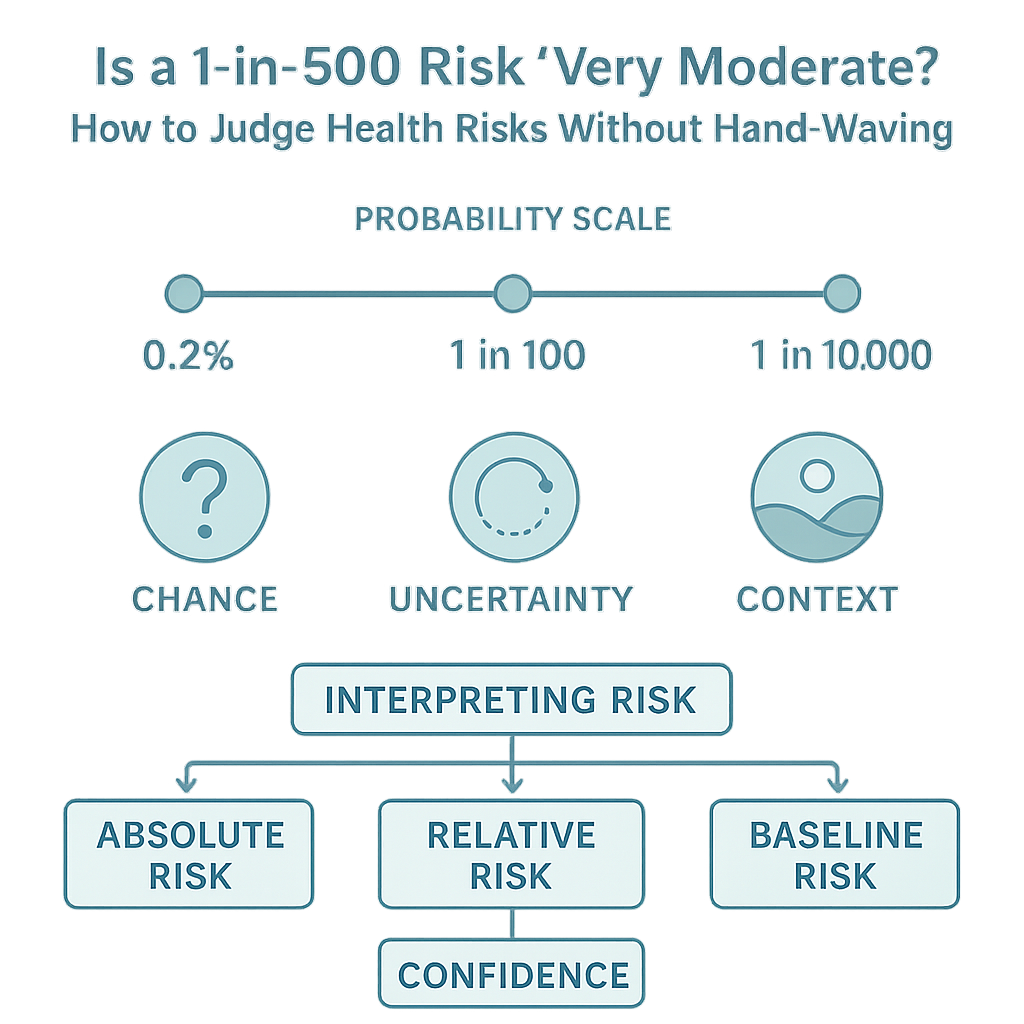
In plain arithmetic, a one-in-500 risk is a 0.2% probability for the specified group and period. That conversion is straightforward. Interpreting it is not. Is the risk per day, per year, per treatment course, or over a lifetime? Does it describe a healthy adult, a high-risk patient, or everyone exposed? Is it an observed rate from a study, a model-based estimate, or a rough comparison? Without those details, the fraction is a headline, not a complete risk assessment.
The original claim refers to a person finding a side effect “worse” than a one-in-500 chance of literal death, then calls the risk “very moderate.” The wording has a clear problem: it treats a grave outcome as though its rarity settles the question. It does not. A small probability of a severe outcome may be acceptable in some circumstances, particularly when the likely benefit is substantial and alternatives are worse. In other circumstances, the same probability may be difficult to justify. The number alone cannot make that decision.
When I assess a risk statement, I first look for its denominator and timeframe. “One in 500” among whom, and over how long? Then I ask what is being compared: death, hospitalization, temporary symptoms, or a mild nuisance? A fair comparison uses outcomes that matter to the person making the choice and applies the same time period wherever possible. Comparing a short-term treatment risk to a lifetime risk from ordinary life can mislead, even if both figures are technically accurate.
The word moderate needs the same scrutiny. It might describe the probability, the severity, or a formal category in a particular risk system. Those meanings are not interchangeable. A 0.2% probability may be low in one technical classification while the potential consequence remains catastrophic. Calling the likelihood “low” does not make the outcome unimportant. And calling it “moderate” without naming the scale tells readers almost nothing.
Risk is not the same as certainty. A 1-in-500 risk does not mean one specific person will die, nor does it mean 499 people are guaranteed to be safe. It is a way to describe probability across a defined set of comparable cases. Individuals may have higher or lower risk because of age, health conditions, medications, environment, and behavior. Population averages do not predict one person’s fate with precision.
This distinction is useful well beyond medicine. Training plans, supplements, restrictive diets, and extreme fitness challenges all involve trade-offs. The body deserves care and respect, not recklessness dressed up as toughness. Stewardship of health means looking at both benefits and harms honestly.
Why risk and benefit both matter
A health decision is rarely a choice between risk and no risk. It is usually a choice among different risks, possible benefits, and the option of doing nothing. A medicine may carry side effects, while an untreated condition also carries dangers. A hard workout may cause injury, while long-term inactivity can contribute to poor health. The meaningful question is not “Is there any risk?” It is “What are the likely outcomes of each available option for this person?”
That is why context matters more than a dramatic phrase. Consider exercise. Physical activity can improve cardiovascular fitness, strength, mobility, sleep, and mood. The U.S. Centers for Disease Control and Prevention’s summary of physical activity benefits describes several established health benefits, while the World Health Organization’s physical activity fact sheet recommends regular movement as part of healthy living. Those benefits do not make every workout sensible. A new exerciser attempting maximal lifts without instruction is making a different choice from a trained athlete following a gradual plan.
Here’s the kicker: benefits are not a magic eraser for harms. A useful assessment asks how likely the benefit is, how large it may be, how soon it might occur, and whether the person has safer or more effective alternatives. It also asks how likely a side effect is, how severe it could be, whether it is reversible, and what warning signs need attention. A small risk of mild soreness is not equivalent to a small risk of death. One number cannot flatten that distinction.
For exercise and wellness, the broad evidence supports regular activity for most people, but people with symptoms, chronic conditions, recent surgery, or medication concerns may need tailored guidance. The CDC’s physical activity guidance and WHO recommendations are starting points for the general public—not personal prescriptions. People with chest pain, fainting, unusual shortness of breath, or other concerning symptoms should not treat an online workout plan as medical clearance.
Nutrition advice needs the same discipline. A diet can lead to weight loss while still being nutritionally inadequate, difficult to sustain, or unsuitable for someone’s medical needs. “Natural,” “clean,” and “extreme” do not tell you whether a diet is safe. Look at the whole pattern: adequate energy, protein, fiber, essential nutrients, cultural fit, cost, and the person’s health history. A supplement’s possible benefit also needs to be weighed against its known risks, interactions, and quality controls.
The moral is not to fear every risk. That would leave a person unable to live, train, or make ordinary decisions. The point is to stop using casual labels to settle serious questions. A sound decision respects uncertainty and keeps the person—not a slogan—at the center.
A practical guide to weighing health risks
- Name the decision. State what is being considered in concrete terms: starting a medication, trying a supplement, returning to running after an injury, or following a demanding training plan. Vague questions produce vague answers. If the plan is “get fitter,” define the actual behavior, such as walking for 20 minutes three days a week or adding two strength sessions.
- Find the source and the population. Look for an authoritative source that explains where its estimate came from. Was the information drawn from a clinical trial, a registry, a systematic review, or a model? Were the people studied similar to the person making the decision? A number from older adults with several medical conditions may not describe a healthy young adult—and the reverse is also true.
- Check the timeframe and denominator. Write down whether the risk is per use, per year, per treatment course, or over a lifetime. Ask whether the denominator is 500 people, 500 sessions, or 500 patient-years. Those are not interchangeable. If a source leaves the period unclear, do not quietly invent one to make the claim sound reassuring or alarming.
- Separate probability from severity. A low probability can still involve a severe outcome. A more likely side effect may be temporary or mild. Consider each outcome separately rather than combining all adverse events into a single bucket. Ask what would happen, how long it might last, whether it can be treated, and what the person would regard as an unacceptable trade-off.
- Compare realistic alternatives. “Do nothing” is not automatically safe. It may mean a disease remains untreated, fitness declines, or a person continues a behavior with its own harms. Compare options using the same outcome and timeframe. In exercise, compare a gradual, appropriately scaled program with inactivity or a sudden high-intensity plan—not with an imaginary risk-free workout.
- Put the number into a usable format. If the evidence supports it, express the risk as a natural frequency: for example, a stated number of cases among a stated number of people over a stated period. Use both the fraction and percentage when helpful. Do not imply that a group estimate predicts exactly what will happen to a particular individual.
- Ask what could lower the risk. For training, that may include gradual progression, suitable footwear, technique coaching, recovery days, and adjusting for symptoms. For nutrition, it may mean checking for medication interactions, avoiding excessive restriction, or talking with a registered dietitian. For medical treatment, it may mean discussing monitoring, dose, alternatives, and warning signs with a qualified clinician.
- Make the choice with the right person. A clinician can help interpret personal health factors; a physical therapist or qualified coach can adjust exercise; a registered dietitian can help with complex nutrition needs. Ask direct questions: “How certain is this estimate?” “What happens if I wait?” “What symptoms mean I should stop?” “What alternatives are available?” Frankly, these questions are more useful than asking whether a risk sounds “moderate.”
- Review the decision when circumstances change. Health decisions are not carved in stone. New symptoms, a new diagnosis, pregnancy, medication changes, or a shift in training load can alter the balance. Revisit the plan rather than assuming the original estimate still applies.
When I analyze a training program, I look for repeatable work, sensible progression, and room for recovery—not heroic claims. The same habits serve risk decisions: define the question, check the evidence, and stay honest about what is unknown. A strong plan is usually less dramatic than the marketing around it.

Risk dismissal versus risk assessment
| Question | Risk dismissal | Careful risk assessment |
|---|
| What does “1 in 500” describe? | Treats the fraction as self-explanatory | Identifies the population, outcome, and timeframe |
| How is severity handled? | Assumes rarity makes severe harm unimportant | Separates probability from the seriousness of the outcome |
| What is the comparison? | Uses whatever comparison sounds persuasive | Compares realistic alternatives over the same period |
| How are benefits treated? | Assumes a benefit cancels any harm—or ignores benefits entirely | Weighs likely benefits, harms, uncertainty, and alternatives |
| What does “moderate” mean? | Uses the word as a reassuring verdict | Names the scale or avoids the label |
| What should the reader do? | Follow someone else’s confidence | Ask informed questions and consider personal circumstances |
The table compares two ways of talking about risk, not two medical treatments. That distinction matters. Risk assessment is a method; “dismissal” is a rhetorical shortcut. In a real medical decision, the best choice may be to accept a risk, reduce it, choose another option, or decline. The evidence and the person’s circumstances determine which option makes sense.
Common mistakes to avoid
Mistake 1: Treating a percentage as the whole story. A percentage without a timeframe or population is incomplete. “0.2%” may refer to a week, a year, or an entire course of treatment. Ask for the missing details before drawing a conclusion. If a claim cannot provide them, treat it cautiously.
Mistake 2: Confusing “rare” with “irrelevant.” A rare event may deserve attention when its consequences are serious and preventable. That does not mean the event is likely to happen to you. It means the decision should account for severity and available safeguards instead of dismissing the outcome as too unlikely to matter.
Mistake 3: Confusing “not zero” with “too dangerous.” The opposite error is also common. Every meaningful activity carries some possibility of harm, including sitting still, driving to a gym, or taking a prescribed medicine. Acknowledging risk is not the same as declaring an option unacceptable. Compare it with realistic alternatives.
Mistake 4: Comparing different denominators. “One in 500 over a lifetime” cannot be fairly compared with “one in 500 per year” without accounting for the time difference. Nor can a rate per session be casually compared with a rate per person. Matching denominators is basic hygiene for risk communication.
Mistake 5: Ignoring individual differences. A population estimate can hide meaningful variation. Age, disability, health conditions, previous injury, medication use, and training experience may change the balance. An average is not a personal forecast. This is one reason medical decisions should not be reduced to internet arguments.
Mistake 6: Treating exercise as either perfectly safe or inherently dangerous. Both claims are nonsense. Exercise can cause strains, falls, or other injuries, especially when load rises too fast or technique is poor. At the same time, regular activity has established health benefits. A sensible workout plan matches the person’s current ability, builds gradually, and includes recovery. For general guidance on physical activity benefits, see the CDC resource and WHO recommendations.
Mistake 7: Believing the “no pain, no gain” slogan. Ordinary effort and muscle fatigue are not the same as sharp pain, chest pressure, faintness, or unusual breathlessness. Pushing through concerning symptoms is not grit; it is poor judgment. Stop and seek appropriate medical guidance when symptoms suggest a potential problem.
Mistake 8: Letting confidence replace evidence. A person may sound certain and still be wrong. A personal story cannot establish how often an event happens, and a confident label cannot show that a risk is acceptable. Look for quality evidence, clear definitions, and an honest account of uncertainty.
Mistake 9: Forgetting the basics while chasing optimization. People can spend hours debating supplements while ignoring sleep, regular movement, balanced meals, and a manageable training schedule. There is no need to chase a perfect routine. Consistency, adequate recovery, and moderation usually beat short-lived extremes.
Frequently asked questions
Is a 1-in-500 chance considered high?
It depends on the outcome, timeframe, population, and alternatives. As a percentage, one in 500 is 0.2%. That describes probability, not the seriousness of the possible outcome. A one-in-500 chance of a temporary nuisance is not equivalent to a one-in-500 chance of death. Ask exactly what the number measures and over what period, then consider whether the estimate applies to the person involved.
Does a 0.2% risk mean one person in every 500 will experience the event?
It means the estimate corresponds to that rate across a defined group or set of comparable cases. It does not identify which particular person will experience the event, and real-world outcomes may differ from the estimate. The number also depends on the study population, measurement methods, and timeframe. It should not be treated as a guarantee that one person will be harmed and everyone else will be safe.
How should I compare the risk of a treatment with the risk of not treating?
Ask a qualified clinician to compare likely benefits and harms for the specific condition and available options. Make sure the estimates refer to similar populations and time periods, and ask what is known versus uncertain. Include the possibility of no treatment, alternative treatments, and monitoring. A general online statistic cannot account for a person’s full medical history or preferences.
Is exercise worth the risk of injury?
For most people, regular, appropriately scaled physical activity offers important health benefits, while sensible programming can reduce avoidable injury risk. Start at a level that suits current fitness, increase workload gradually, and allow recovery. People with significant symptoms, relevant health conditions, or specific medical concerns should ask a clinician what kinds of activity are appropriate. Exercise is not risk-free, but neither is inactivity.
Final thought
A risk estimate should sharpen a decision, not silence questions. “One in 500” is useful only when it comes with the details that explain who is affected, over what period, and by which outcome. The same is true of claims about supplements, diet plans, exercise programs, and medical treatments. Numbers deserve attention; labels like “very moderate” do not deserve automatic trust.
That does not mean every small probability should stop a person from acting. It means the possible benefit and harm should be compared honestly, with severity, alternatives, and individual circumstances in view. A responsible choice may involve accepting a known risk for a meaningful benefit. It may also involve choosing a safer approach, asking for better evidence, or declining. The answer depends on the situation—not on a clever sentence designed to make concern sound silly.
For everyday health, keep the basics sturdy: move regularly, build strength at a sensible pace, eat a varied and adequate diet, sleep enough, and seek qualified help when symptoms or medical questions warrant it. Health is not a contest in ignoring warning signs. It is something worth caring for with patience and good judgment. And if someone calls a potentially fatal outcome “very moderate,” ask the useful questions before taking their confidence as proof.