Calling a health policy “Tuskegee 2.0” is a grave accusation. The phrase should trigger scrutiny, not substitute for it: the historic study involved...
MAHA and “Tuskegee 2.0”: What the Allegation Gets Right—and What Evidence Must Show
Calling a health policy “Tuskegee 2.0” is a grave accusation. The phrase should trigger scrutiny, not substitute for it: the historic study involved deception, denied treatment, and serious abuse of Black men, while any present-day comparison must be tested against documented actions, affected people, and evidence of harm. Anger can be warranted; accuracy still matters.
What Does “MAHA and Tuskegee 2.0” Mean?
MAHA is short for “Make America Healthy Again,” a political slogan and health-policy movement associated with calls to address chronic disease and scrutinize parts of the food, medical, and public-health systems. It is not one clinical trial, one agency, or one uniform policy. That matters. A broad movement can include different people, proposals, and actions, which have to be assessed on their own terms.
The statement that people who “enabled, promoted, and normalized MAHA” are to blame for an “attempt to do Tuskegee 2.0” is a serious political and ethical charge. But the statement, on its own, does not name the alleged program, identify who was recruited or harmed, describe what treatment or information was withheld, or cite evidence of intent. Without those particulars, readers cannot distinguish a substantiated warning from a rhetorical comparison. That is not a defense of anyone; it is the minimum standard for checking a claim this severe.
The historical reference is clear. The U.S. Public Health Service’s Tuskegee Study of Untreated Syphilis in the Negro Male ran from 1932 to 1972. It involved 600 Black men in Alabama: 399 with syphilis and 201 without it. Participants were misled about the nature of the research, and effective treatment was not properly provided to the men with syphilis, even after penicillin became the accepted treatment. They were not deliberately infected as part of the study; that misconception should not be repeated. The CDC’s history of the Tuskegee Study outlines the documented abuses.
Tuskegee was not simply a case of “bad communication.” It was a prolonged breach of trust, with serious failures around informed consent, protection from harm, and fair treatment. The Belmont Report, produced after the scandal and other research abuses, sets out three central principles: respect for persons, beneficence, and justice. Those principles help assess research today, though no checklist can undo an injury or replace accountability.
When I analyze a comparison to Tuskegee, I look for the facts beneath the metaphor: Who made the decision? What was done? What did affected people know and agree to? Were they denied established care? What do records, oversight reviews, and independent investigations show? Frankly, without answers, the accusation is a question to investigate—not a finding that can be treated as proven.
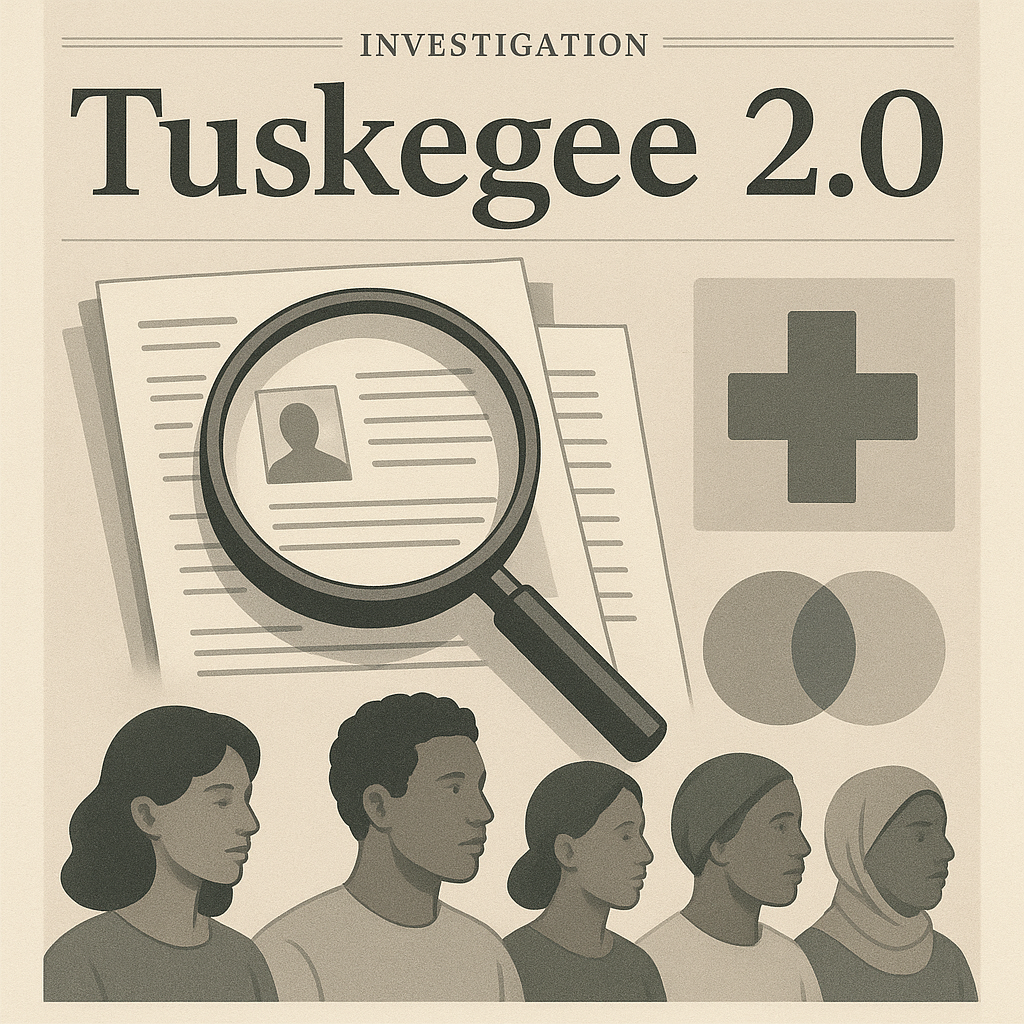
Why the Comparison Matters
A historical analogy can raise an important alarm. It can also muddy the facts if used carelessly. Tuskegee sits in public memory because it shows what can happen when powerful institutions exploit people with less power, conceal information, and treat human beings as instruments for someone else’s goals. That history deserves more than a slogan.
- It reminds institutions that consent must be meaningful. A signed form is not enough if a participant does not understand the purpose, likely risks, alternatives, and right to leave. Consent should be voluntary, informed, and understandable to the person giving it.
- It makes justice a practical test. Researchers should ask who bears risks and who receives benefits. Recruiting a group with fewer choices, then leaving that group without appropriate care, is an ethical warning sign.
- It demands attention to unequal power. Poverty, racism, language barriers, disability, immigration concerns, and dependence on a clinic or public program can make it harder to refuse. That does not mean people in those situations cannot choose to participate; it means safeguards must account for the pressure they may face.
- It supports transparency and independent review. A research team should not be the only judge of its own conduct. Institutional review boards and other oversight bodies are meant to examine whether risks are reasonable and rights are protected.
- It gives people a reason to question comforting reassurances. “Trust us” is not a safety plan. Clear protocols, adverse-event reporting, accessible complaints processes, and honest public communication matter more.
The benefits of drawing attention to possible misconduct are real. People who spot a credible safety problem should be able to report it without being dismissed as troublemakers. Researchers and public agencies should respond to specific concerns with records and explanations, not insults or vague appeals to authority. That is true whether a policy is popular, unpopular, or attached to a political brand.
But the costs of a loose comparison are real too. Labeling a program “Tuskegee 2.0” without showing how it resembles the historical abuse can inflame suspicion while obscuring what actually happened. It can also make future warnings less persuasive. If every flawed policy is called an atrocity, the term loses its ability to signal an atrocity.
The right response is neither automatic agreement nor reflexive dismissal. Ask for the evidence, examine it independently, and protect anyone who may be at risk while the facts are checked. That is less dramatic than a sweeping condemnation, but it is more useful to the people whose welfare is supposedly at stake.
The Belmont Report provides a useful starting point for that work. It is not a magic shield against misconduct; ethical principles need enforcement, honest leadership, and a willingness to stop a study when the facts demand it. A healthy public-health system should welcome that scrutiny rather than treat it as disloyalty.
How to Assess a Serious Allegation Step by Step
I would not begin by deciding whether the accusation sounds emotionally convincing. I would begin by asking what precisely is alleged, then follow the evidence. Here is a practical sequence for journalists, clinicians, advocates, and ordinary readers.
- Identify the specific action. Is the claim about a clinical trial, a vaccination or treatment campaign, a change in public-health guidance, or a proposed program? Name the policy, institution, dates, and decision-makers. A broad movement label cannot tell you which conduct needs review.
- Separate facts from interpretation. Write down what is documented, what is alleged, and what remains unknown. A memo, consent form, public statement, or oversight finding may support one part of a claim without proving every conclusion drawn from it.
- Check what participants were told. Look for consent documents, recruitment scripts, translated materials, and explanations of alternatives. Did participants understand that they were in research? Were risks and the right to withdraw stated plainly? Did staff have a way to check understanding?
- Examine access to established care. A key feature of the Tuskegee scandal was the failure to provide appropriate treatment to men with syphilis. Ask whether people were denied, delayed, or misled about care that was already available. Distinguish that from a policy dispute about whether a particular intervention works; they are not automatically the same thing.
- Review risks, oversight, and safety monitoring. Was there independent review before the work began? Were risks proportionate to expected benefits? Could participants report problems? Were adverse events recorded and acted on? The U.S. Department of Health and Human Services overview of the Common Rule describes federal protections for many kinds of human-subjects research, although rules differ by setting and not every public-health activity is governed identically.
- Ask who was selected and who benefits. Did recruitment target people because they were easy to reach or less able to refuse? Were potential benefits shared fairly? Did the people exposed to risk have a real say in how the work was designed?
- Seek independent corroboration. Compare the original documents with findings from inspectors, ethics boards, courts, professional bodies, or credible investigative reporting. A viral post may point toward a record worth checking; it is not a replacement for that record.
- Use an accurate comparison. Say what is similar and what is different. If the evidence shows a consent failure, name that failure. If there is proof of treatment being withheld, specify it. Avoid claiming equivalence to Tuskegee unless the facts support the comparison.
- Protect people while facts are gathered. A credible, immediate safety concern deserves timely review even before every detail is known. That can mean pausing recruitment, preserving records, notifying oversight bodies, or ensuring access to care. Responsible caution is not the same as declaring guilt in advance.
There is no need to choose between humane concern and evidentiary discipline. In fact, they belong together. Care for the body means taking real risks seriously, while respect for the dignity of each person means not turning their story into a prop for a political argument. Health is something to steward with humility, not a reason to silence people or to make claims about them without proof.

Comparison: Tuskegee and a Contemporary Allegation
| Question | Tuskegee Study: documented history | A present-day “Tuskegee 2.0” allegation |
|---|
| What is established? | A 40-year U.S. Public Health Service study involving 600 Black men in Alabama; 399 had syphilis and 201 did not. | The supplied statement names MAHA and alleges an attempted repetition, but identifies no specific program or decision. |
| What happened to participants? | Men with syphilis were not properly given effective treatment; participants were misled about the research. | The statement does not specify whether anyone was enrolled, deceived, denied care, or harmed. Those details require evidence. |
| What is the basis for evaluation? | Historical records and investigations document the study and its ethical failures. | Relevant evidence could include protocols, consent records, agency decisions, monitoring data, complaints, and independent findings. |
| What does the comparison establish? | The case is a documented example of research abuse and a warning about exploitation and institutional deception. | A comparison may raise questions, but the phrase alone does not prove that a modern policy is equivalent or that an attempt occurred. |
| What should happen next? | Preserve the history, acknowledge the harm, and improve protections and accountability. | Identify the concrete conduct, investigate credible risks, protect affected people, and describe findings precisely. |
The comparison table is not a verdict on MAHA. It reflects the information in the accusation provided here and the documented history of Tuskegee. A more specific allegation may support a more specific assessment. That is why naming the program, decision, or record matters.
Common Mistakes to Avoid
Mistake one: treating a historical analogy as proof. A comparison can be a useful warning, but it cannot establish who did what. “This looks like Tuskegee” is the start of an argument, not its conclusion. Show the conduct and the record.
Mistake two: reducing Tuskegee to a vague lesson about trust. The men were not simply “left out of the conversation.” They were misled and deprived of proper treatment. Their experiences deserve accurate description, not a softened summary that makes the history easier to digest.
Mistake three: repeating false details. The study did not deliberately infect the participants. That correction does not make the study harmless; it keeps the account factual. Correcting misinformation about history is part of respecting the people who lived through it.
Mistake four: assuming every MAHA supporter shares one plan. Political movements can contain competing proposals and people with different motives. Criticize actual policies and decisions. Do not claim that every person associated with a broad label intended the same harm unless evidence supports that claim.
Mistake five: waving away criticism as partisan noise. Public-health decisions can affect lives, and institutions have made serious mistakes. A politically inconvenient concern still deserves a fair, timely review. Dismissing critics without examining evidence is not scientific rigor; it is just another way to avoid scrutiny.
Mistake six: treating a consent form as proof of ethical consent. People can sign documents they do not understand or feel pressured to accept. Good consent involves clear explanations, a real opportunity to ask questions, and freedom to refuse or withdraw without unfair punishment.
Mistake seven: assuming oversight guarantees safety. Review boards, regulations, and written procedures can reduce risk, but they are not infallible. Protections work only when people report problems, leadership responds, and independent reviewers can see what is happening.
Mistake eight: confusing policy disagreement with research abuse. Disagreeing about nutrition advice, a medical recommendation, or a public-health rule does not by itself show that participants were deceived or denied treatment. Those claims need distinct evidence. If the complaint is about poor evidence or a bad policy, say that; it may be serious enough without borrowing a historical atrocity.
Here’s the kicker: careful language does not blunt accountability. It makes accountability harder to evade. “The consent documents misrepresented the study,” if established, is a concrete charge that can be investigated. Broad condemnation may feel satisfying, but it often gives the target a simple way to argue about tone instead of answering the facts.
Frequently Asked Questions
Was the Tuskegee Study an experiment that deliberately infected Black men?
No. The 600 men in the study were not deliberately infected as part of it. The group included 399 men with syphilis and 201 without it. The study’s documented abuse included deception and failure to provide proper treatment to men with syphilis, even after effective treatment was available. The distinction matters because accurate history should not need an invented detail to make the documented wrongdoing clear.
Does calling something “Tuskegee 2.0” prove it is equivalent to the original study?
No. It signals a serious comparison that should be examined, but the phrase alone does not prove equivalence, intent, or harm. To assess it, identify the specific program and review what participants were told, whether they could refuse, whether care was withheld, and what independent oversight found.
What is MAHA?
MAHA means “Make America Healthy Again.” It is a political slogan and movement connected to proposals and arguments about health. It is not one research protocol or a single uniform policy. As a result, claims about a particular MAHA-related action should identify that action rather than treating the movement as though it were one clinical study.
How can someone report a concern about human-subjects research?
Start with the study’s consent materials and the contact information for its research team or ethics review board. Depending on the study, concerns may also be directed to a hospital, university, sponsor, regulator, or relevant public agency. For immediate danger, seek urgent medical help. Preserve relevant records and describe what happened as specifically as possible; a clear report is easier to investigate.
Final Thought
History does not require us to use its worst chapters as catchphrases. Tuskegee should sharpen our standards: participants must be treated as people with agency, not as convenient sources of data; risks and alternatives should be explained; established care must not be withheld through deception; and institutions must answer to independent review. Those are demanding requirements, and they should apply regardless of which political group proposes a policy.
The allegation that MAHA’s enablers are collectively responsible for an attempt to repeat Tuskegee is too serious to accept or dismiss on a single sentence. The statement provided here does not name the program or present evidence of the alleged attempt. That gap does not settle the issue. It tells us what is needed next: a precise account, records that can be checked, testimony from affected people, and an investigation with enough independence to publish uncomfortable findings.
I favor skepticism in both directions. Do not assume a powerful institution is trustworthy just because it says so. Do not assume a grave accusation is true just because it names a grave historical wrong. Ask for evidence, listen to people who may have been harmed, and keep the language proportionate to what the record supports. Protecting human dignity and telling the truth are not competing duties; each one makes the other more credible.