Nicotine Pouches and Coronary Artery Disease: What the Evidence Says
Nicotine pouches are not cigarettes, but neither are they cardiovascularly inert. For someone with coronary artery disease (CAD), the key question is not whether smoke and nicotine are identical—they are not—it is whether a nicotine dose can add avoidable strain to a heart already affected by plaque. The honest answer is that evidence is incomplete, and personal medical advice matters.
I previously argued that nicotine had been unfairly blamed for many harms caused by cigarette smoke. I still think the distinction matters. A cigarette delivers nicotine along with combustion products, including carbon monoxide and numerous toxic chemicals that injure blood vessels; a pouch avoids inhaled smoke, but it still delivers an active drug into the body.
That difference became personal after a coronary CT angiogram showed that I have coronary artery disease. I had been using an occasional 4 mg pouch before tennis or paddle, enjoying the alert feeling and the small psychological lift. I stopped as soon as I learned about the diagnosis. The quick decision surprised me: I usually tell patients to weigh evidence rather than react to fear, yet my first response was to put the pouch aside and ask questions later.
The questions are worth asking. Does an occasional pouch trigger a heart attack? Does the answer depend on the amount of plaque, symptoms, medications, or the nicotine dose? The research cannot give a confident yes-or-no answer for every person with CAD. This article separates what is known from what remains uncertain; it is not a personal clearance to use nicotine or a substitute for care from a clinician who knows your medical history.
What Is Nicotine, and How Is It Different From Smoking?
Nicotine is a drug found naturally in tobacco. It activates nicotinic acetylcholine receptors and stimulates the sympathetic nervous system, the body’s quick-response system. That stimulation can prompt the release of catecholamines such as adrenaline, temporarily increasing heart rate and blood pressure. Nicotine may also affect blood-vessel tone and the balance between oxygen supply and demand in the heart.
Those are real effects. They do not, by themselves, tell us how often a particular product causes heart attacks or cardiovascular deaths. That gap between a measurable short-term response and a proven long-term outcome is central to the debate. A rise in pulse is not the same thing as a demonstrated increase in clinical events; equally, the absence of long-term pouch studies is not proof that pouches are harmless.
Cigarette smoke adds a much larger set of exposures. It contains carbon monoxide, fine particles, oxidants, and other toxic chemicals associated with vascular injury, inflammation, and clotting. Nicotine sustains dependence and contributes to the body’s response, but it is not accurate to treat nicotine and cigarette smoke as interchangeable. The review on nicotine and cardiovascular toxicity explains why the delivery method matters while also describing nicotine’s physiological effects.
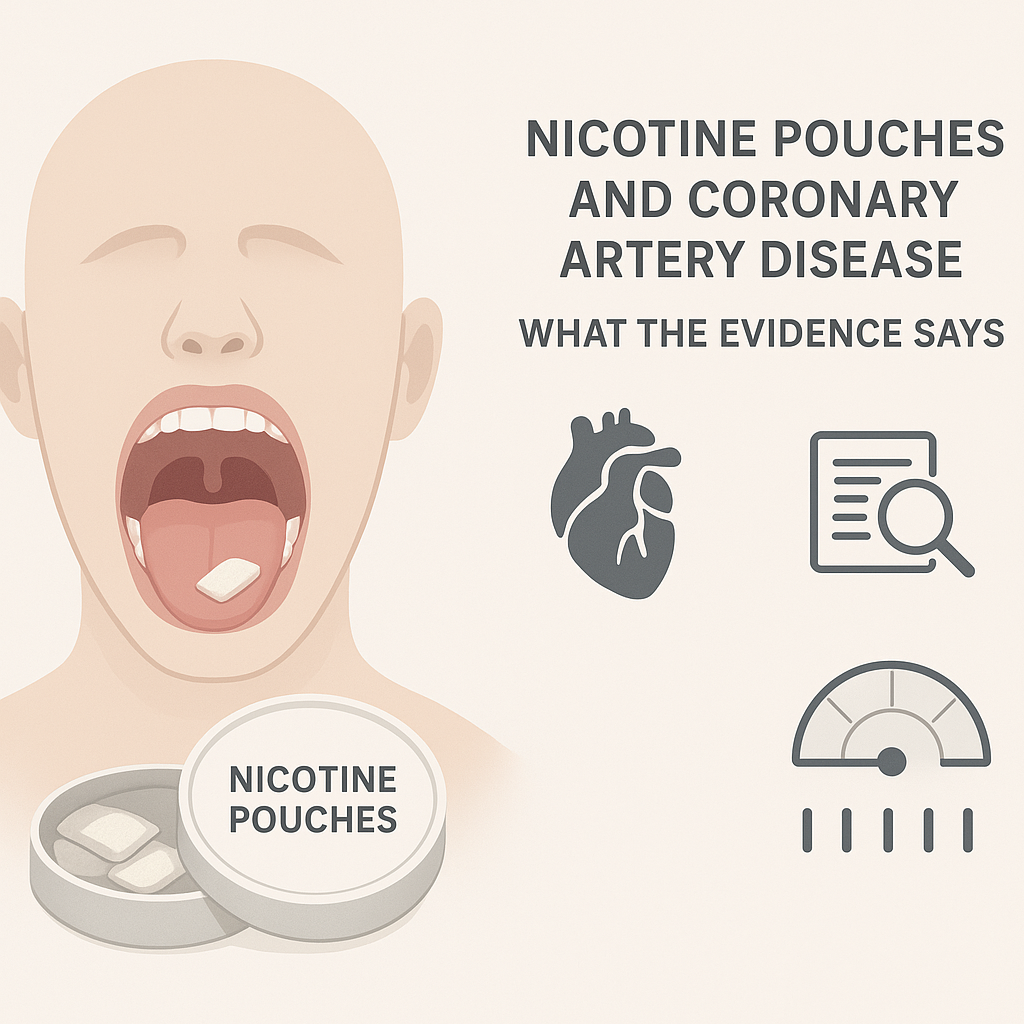
Nicotine pouches are placed between the lip and gum. They do not involve burning tobacco or inhaling smoke, but they do expose the user to nicotine through the mouth. The dose printed on a pouch is not necessarily the exact amount absorbed; product formulation, time in the mouth, and individual use patterns can affect exposure. The CDC’s overview of nicotine pouches notes that these products can contain addictive nicotine and that their health effects are still being studied.
Here is the kicker: less exposure to combustion toxins is a meaningful difference, not a guarantee of cardiovascular safety. Pouches can cause dependence, and their long-term effects are not as well established as the harms of smoking. If someone has CAD, that uncertainty deserves more weight than it would in an abstract argument about nicotine.
Why the Distinction Matters: Potential Benefits and Real Limits
There is a sound reason not to collapse every nicotine product into one category. People who smoke are exposed to nicotine and to the damaging chemicals produced by burning tobacco. For smokers trying to quit, approved nicotine replacement therapy—such as patches, gum, or lozenges—can reduce withdrawal and help them stop smoking. Replacing cigarettes with a medically appropriate cessation treatment is not the same decision as starting recreational nicotine use.
The U.S. Food and Drug Administration’s information on smoking-cessation medicines describes nicotine replacement as a tool for quitting tobacco. Its purpose is to help people move away from the more dangerous exposure of smoking. That context matters: evidence that a treatment can support smoking cessation does not establish that nicotine is beneficial for a person who does not smoke, nor does it prove that every pouch has the same safety profile as regulated replacement products.
Nicotine can produce a short-lived feeling of alertness. Some users report better concentration or a sense of stimulation before sport. Those are subjective effects, not proof of improved athletic performance or heart health. Nicotine is not an evidence-based pre-workout supplement for people with coronary disease, and the potential for dependence is a poor trade for a fleeting boost.
The cardiovascular concern is straightforward. When nicotine raises pulse and blood pressure, the heart may need more oxygen. In a person with narrowed coronary arteries, that extra demand could matter, particularly during vigorous activity or in the presence of symptoms. Whether an occasional pouch actually precipitates a coronary event in a given person is a different, harder question; current evidence does not let us calculate that individual risk reliably.
Research on nicotine replacement offers some useful context, but it has boundaries. A Cochrane review of nicotine replacement therapy for smoking cessation examines treatment used to help smokers quit. Studies of that kind cannot be treated as direct proof about long-term pouch use in a non-smoking person with known CAD. Product, dose, pattern of use, and the person’s underlying health all differ.
Frankly, the fairest conclusion is neither nicotine is just as bad as cigarettes nor nicotine is harmless. Nicotine has real physiological effects; smoke adds major toxic exposures; and the absence of robust outcome data for pouches leaves important questions unanswered. My own earlier interest in possible therapeutic uses does not change that. A potential research application is not a recommendation for self-treatment.
A Step-by-Step Guide for Someone With CAD
- Pause recreational nicotine while you get individualized advice. If a scan or clinician has identified CAD, stopping a nonessential nicotine product while the situation is clarified is a cautious, reasonable step. It avoids adding a stimulant effect before you know how your disease, medications, and symptoms fit together. This is not the same as abruptly stopping prescribed medication; keep taking heart medicines as directed unless your clinician tells you otherwise.
- Find out what the scan actually showed. A coronary CT angiogram can show plaque and help assess narrowing, but the report’s details matter. Ask your cardiologist what the findings mean, whether any arteries are significantly narrowed, and how your overall risk is affected by blood pressure, cholesterol, diabetes, family history, and prior symptoms. A diagnosis alone does not tell a stranger how much risk a specific pouch would add.
- Describe your nicotine use precisely. Share the product, labeled strength, how often you use it, how long you keep it in your mouth, and whether you use any other nicotine or tobacco products. Mention when you use it—especially if it is before exercise. I would not assume that “only occasional” automatically means “no effect”; a clinician needs a usable description, not a reassuring label.
- Separate quitting support from recreational use. If you currently smoke or are trying to quit, ask your clinician about evidence-based cessation options. For many people, stopping cigarettes is a major health priority, and a suitable nicotine replacement plan may be safer than continuing to smoke. Do not substitute a pouch for a prescribed treatment without discussing it, and do not assume that data on cessation medicines automatically apply to all commercial pouches.
- Get a clear exercise plan. Tennis and paddle can involve hard bursts of effort, and the appropriate level depends on symptoms, test results, fitness, and treatment. Ask whether you can continue, whether you need a gradual return, and whether cardiac rehabilitation or a supervised exercise assessment is appropriate. A heart diagnosis does not automatically mean “stop moving”; it means the plan should fit the person, not a generic gym slogan.
- Know when symptoms need urgent attention. Chest pressure, unusual shortness of breath, fainting, or discomfort spreading to the arm, jaw, back, or shoulder should not be brushed off as a nicotine effect or a bad workout. Follow your clinician’s emergency plan and seek urgent help for possible heart-attack symptoms. Do not try to test your limits by taking another pouch and seeing what happens.
- Revisit the decision with your cardiologist. Ask what is known, what is uncertain, and whether any circumstances make nicotine particularly unwise for you. If you are advised to avoid it, ask how long that recommendation applies and whether it changes with treatment or stable disease. If you disagree, ask for the reasoning and evidence rather than treating a quick internet search as a second opinion.
I stopped first and investigated afterward. That is a personal response, not a clinical rule for everyone. The useful approach is to make the risk decision with someone who knows your coronary findings and the reason you want nicotine in the first place.
Nicotine Pouches vs. Cigarettes: What the Comparison Can—and Cannot—Tell Us
The comparison below is about exposure and evidence, not a claim that either product is safe. Cigarette harms are supported by extensive research and public-health data. Nicotine pouches are newer, and the evidence base is less mature, particularly for long-term cardiovascular outcomes and people with established CAD.
| Feature | Nicotine pouches | Cigarettes |
|---|
| Delivery | Nicotine is absorbed through the mouth; no smoke is inhaled. | Nicotine is inhaled with smoke created by burning tobacco. |
| Combustion products | Avoids cigarette smoke and its combustion products. | Exposes the user to carbon monoxide, particles, and many toxic chemicals. |
| Nicotine effects | Can raise heart rate and blood pressure; may contribute to dependence. | Nicotine has similar drug effects, alongside the harms of smoke exposure. |
| Cardiovascular evidence | Long-term outcome data are limited, especially for people with CAD. | Strong evidence links smoking with cardiovascular disease and events. |
| Established role | Not a proven cardiovascular treatment; products vary. | No health benefit; stopping smoking is a major risk-reduction goal. |
The key point is not that pouches are as harmful as cigarettes. The key point is that a meaningful reduction in smoke exposure does not answer every question about nicotine itself. An individual with CAD may reasonably care about even a possible temporary increase in heart workload, while a smoker trying to quit may have a different risk-benefit calculation because the alternative is continued smoking.
Likewise, evidence from nicotine replacement therapy should be read in context. It is used to help people stop smoking, often for a limited period and with dosing instructions. A recreational pouch may differ in strength, use pattern, and formulation. Even when products share an active ingredient, they are not automatically interchangeable in clinical evidence.
So use the comparison to avoid a false equivalence, not to declare a winner. Cigarette smoke is a well-established cardiovascular hazard; nicotine pouches remove smoke exposure but still deliver an addictive drug whose long-term effects in CAD are not fully mapped. That is a real distinction—and a real uncertainty.
Common Mistakes to Avoid
Mistake 1: Treating nicotine as identical to cigarette smoke. This muddies the science. The combustion products in smoke contribute heavily to cardiovascular harm, and a pouch does not create those inhaled exposures. But the opposite error—assuming that no smoke means no cardiovascular concern—is just as sloppy. Nicotine itself changes cardiovascular physiology.
Mistake 2: Assuming that a short-term body response proves a heart attack will happen. A temporary rise in pulse or blood pressure is not direct evidence that an occasional pouch will cause an event. It is a physiological signal that may matter more for some people than others. The right response is careful interpretation, not panic or dismissal.
Mistake 3: Assuming that limited evidence proves safety. Pouches have not been studied for as long as cigarettes, and their use patterns vary. If large long-term studies are missing, the honest answer is that researchers cannot confidently describe every long-term outcome. “Not yet demonstrated” does not mean “demonstrated to be harmless.”
Mistake 4: Borrowing evidence from smoking-cessation treatment without checking the context. Nicotine replacement products are used to help people stop smoking. That benefit must be weighed against the danger of ongoing cigarette use. It does not automatically justify recreational nicotine in someone who does not smoke or settle the question for a person with known CAD.
Mistake 5: Treating a workout as proof of safety. Feeling fine during a game does not reveal what is happening in the coronary arteries or predict future risk. Nor should a CAD diagnosis be used to frighten someone away from all activity. Ask for an exercise plan based on your findings, and follow it consistently.
Mistake 6: Ignoring dependence because use feels occasional. Nicotine is addictive. A habit that starts as a rare pre-game ritual can become more frequent, especially when people associate the product with focus or performance. Be honest about how often you reach for it; self-assessment works better when it is specific.
Mistake 7: Trying to settle a personal medical decision with a general headline. Population-level findings cannot tell one person with CAD whether a pouch is safe before a particular match. The degree of disease, treatment, symptoms, and dose all matter. The body deserves care as something entrusted to us—not punishment, and not a test subject for internet certainty.
Frequently Asked Questions
Are nicotine pouches safer than cigarettes for the heart?
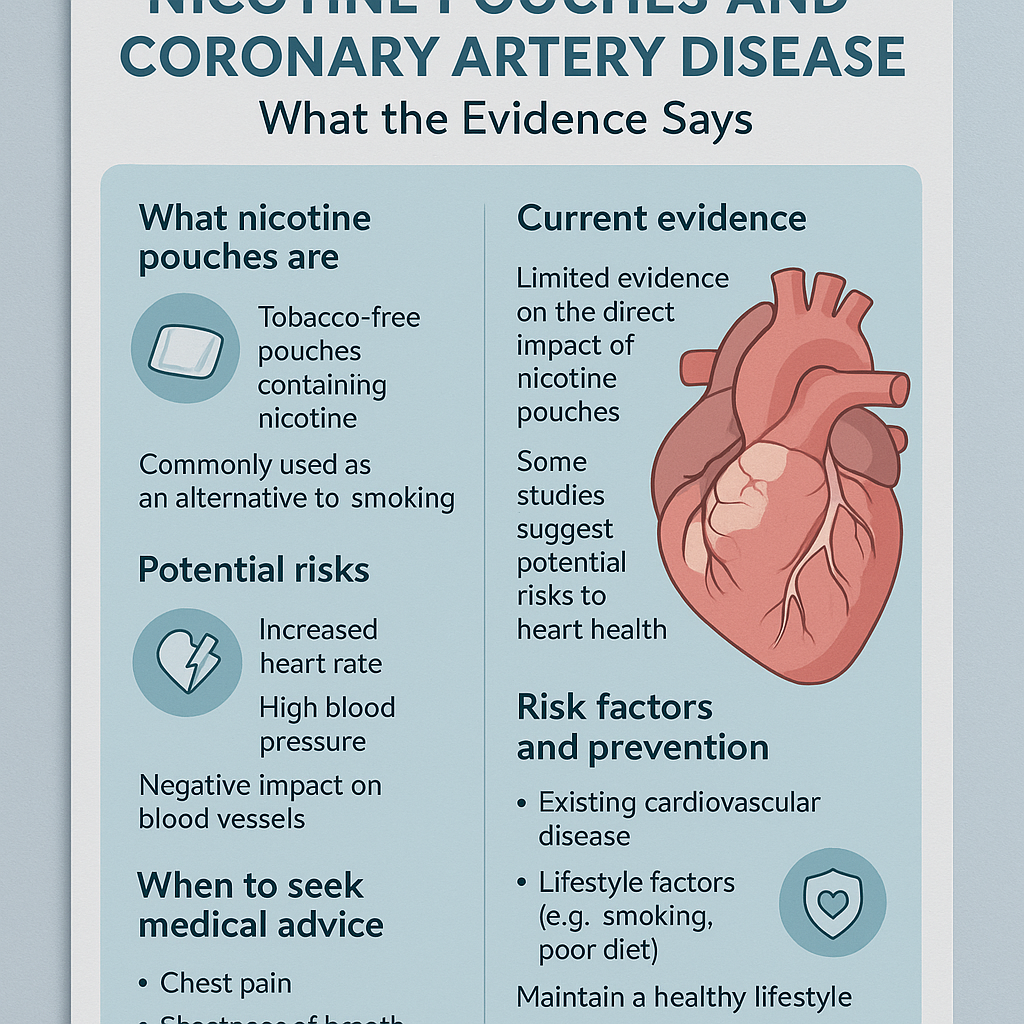
They avoid inhaled smoke and the toxic products of tobacco combustion, so the exposure is different from smoking. Cigarette smoking is a well-established cardiovascular hazard. However, nicotine pouches still deliver nicotine, which can raise heart rate and blood pressure, and long-term cardiovascular evidence for pouches is limited. Safer than smoking in some respects does not mean safe for every person or appropriate for someone with CAD.
Can nicotine trigger a heart attack if I have coronary artery disease?
There is not enough evidence to give a reliable yes-or-no answer for an individual. Nicotine can increase the heart’s workload, which is a reason for caution, but a short-term change in heart rate or blood pressure is not proof that a pouch will trigger an event. Ask your cardiologist to interpret your specific scan, symptoms, and risk factors. Seek urgent help for symptoms that could signal a heart attack.
Is nicotine replacement therapy the same as using a pouch?
No. Nicotine replacement therapy is used as a smoking-cessation aid and has its own product standards, dosing guidance, and evidence base. Commercial pouches may differ in dose, formulation, and pattern of use. Evidence supporting a cessation treatment does not establish that recreational pouch use is beneficial or safe for a person with coronary disease. If you are quitting smoking, discuss approved options with a health professional.
Should I stop exercise after a CAD diagnosis?
Not necessarily. Physical activity is often part of heart-health care, but the appropriate type and intensity depend on your test results, symptoms, and treatment. Ask your cardiologist whether you can continue your usual sport, need a gradual return, or would benefit from cardiac rehabilitation. Do not use nicotine to push through chest discomfort, unusual breathlessness, dizziness, or other warning signs.
Final Thought
My first reaction to the diagnosis was simple: stop the nicotine pouch. Later, I wanted to know whether that quick choice was evidence-based or just fear wearing a sensible coat. The answer is more nuanced than either side of the argument usually admits. Cigarettes and nicotine are not the same exposure, and separating them matters. But nicotine is not physiologically neutral, and the evidence on pouches in people with established coronary artery disease is not strong enough to offer blanket reassurance.
That leaves room for honest uncertainty. If nicotine replacement helps a smoker leave cigarettes behind, the comparison may favor a clinician-guided cessation plan. If someone who does not smoke is using a pouch for a brief lift before sport, the expected benefit is modest, while the cardiovascular risk for a particular person with CAD is unclear. Those are different decisions, and they should not be collapsed into one slogan.
For me, the sensible next step is not to pretend that one article can settle the matter. It is to understand the scan, ask a cardiologist about the actual risk, and choose an exercise plan that supports health rather than gambling with it. Caring for the body is a form of stewardship; it calls for moderation, evidence, and the humility to admit when the data have not caught up with our preferences. A pouch may be small. The decision deserves more than a guess.