The claim that a new “vaccine injury clinic” opened at the National Institutes of Health deserves scrutiny, not instant applause or dismissal. The supplied...
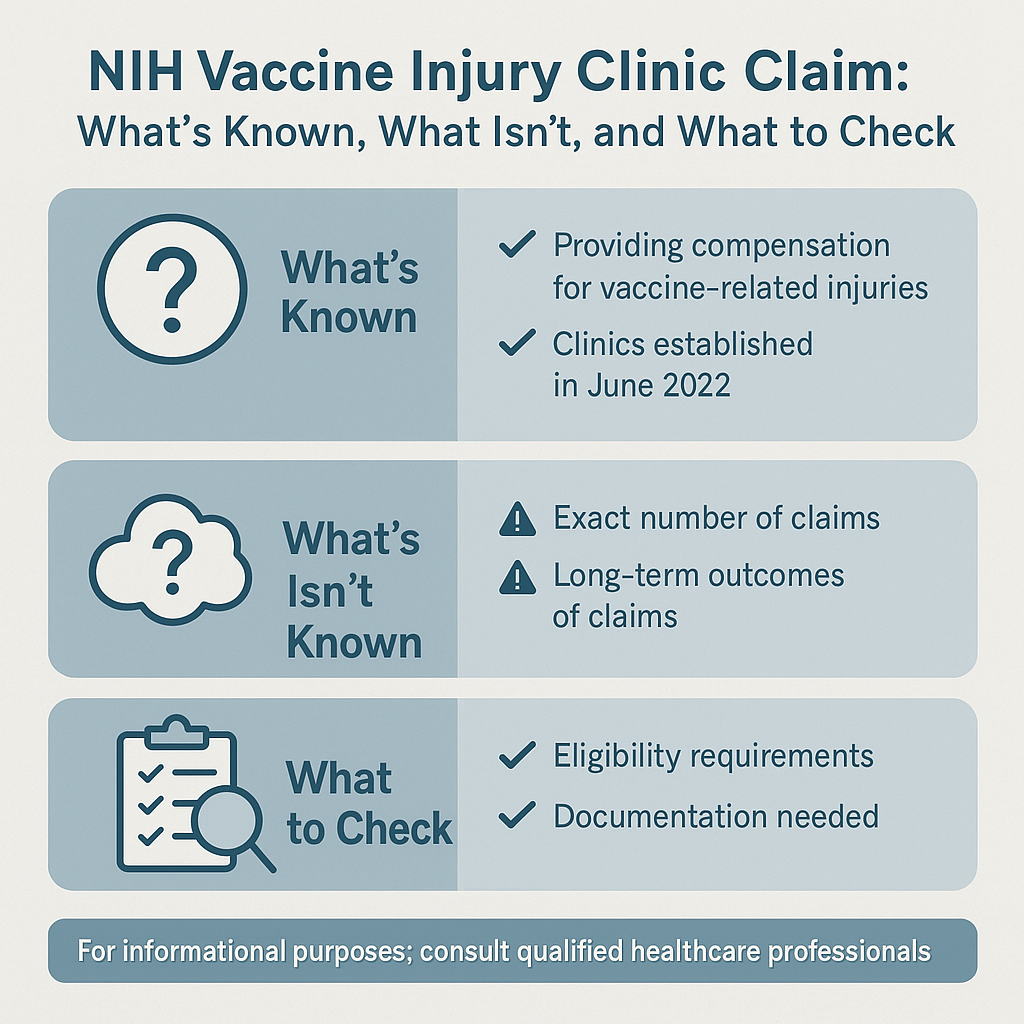
NIH Vaccine Injury Clinic Claim: What’s Known, What Isn’t, and What to Check
The claim that a new “vaccine injury clinic” opened at the National Institutes of Health deserves scrutiny, not instant applause or dismissal. The supplied statement does not identify an official announcement, the clinic’s name, its funding, its leadership, or the services it offers. Without those details, calling the program either a sham or a functioning medical center goes beyond what the claim establishes.
That distinction matters. People with suspected vaccine-related health problems need respectful medical evaluation, while the public needs accurate information about how a federal clinic is funded, staffed, and governed. Those are compatible aims. Here is how to assess the report, understand the existing systems, and separate evidence from political shorthand.
Key Takeaways- The claim provided does not, by itself, verify that a clinic has opened or establish its budget, structure, or leadership.
- VAERS is a reporting system, not a way to prove that a vaccine caused an individual event.
- HRSA’s Countermeasures Injury Compensation Program is a federal compensation program, not the same thing as a medical clinic.
- A credible NIH program should disclose its clinical purpose, eligibility rules, staff, funding, oversight, and how it will assess causality.
- Patients deserve careful care and straight answers; neither reflexive dismissal nor unsupported causal claims help them.
What is the reported NIH vaccine injury clinic?
The supplied claim describes a “vaccine injury clinic” at NIH and says no budget, structure, or leadership was announced. It also characterizes the program as a sham serving a political campaign against vaccines. Those are several different claims packed into one sentence: that a clinic opened, that important operational information is missing, and that the program’s purpose is deceptive or politically motivated. Each needs separate evidence.
A clinic, in the ordinary sense, provides patient care through defined services and qualified staff. A research program may instead recruit participants, collect medical histories, test hypotheses, or study possible mechanisms without providing comprehensive treatment. A referral service, a research cohort, a grant initiative, and a clinical facility are not interchangeable, even if public officials or news reports use informal labels for them. What exactly is being offered?
NIH is a federal research agency made up of institutes and centers. A program associated with NIH could involve one institute, an intramural research team, an outside grant recipient, a partner hospital, or a referral arrangement. Its location alone would not tell us who is responsible for clinical decisions or who pays for care. The key documents are the formal announcement, program description, funding notice, leadership roster, protocol, and any patient eligibility or referral guidance.
I would not treat the word “injury” as proof of causation. It can describe a person’s experience or the question being investigated; it does not establish that a vaccine caused a condition. Good medicine starts with the symptoms, timeline, medical history, examination, and appropriate tests. A clinician then considers competing explanations and the limits of what current evidence can show.
The converse is just as important. Uncertainty is not a reason to sneer at a patient or refuse a serious evaluation. Some medical problems are difficult to diagnose, and people can suffer whether or not a suspected cause is ultimately confirmed. A responsible system takes the complaint seriously without promising an answer the evidence cannot support.
The original statement gives no source that independently confirms an opening or describes the program. Until a primary NIH or HHS document, a detailed report quoting officials, or verifiable program materials are available, the most accurate framing is that the claim is unverified from the information supplied. That is not proof that it is false. It is a reason to withhold a confident verdict.
Why a transparent program could matter
Patients with persistent or unexplained symptoms need competent care, not a political litmus test. A well-designed clinical program could help doctors characterize symptom patterns, test diagnostic approaches, coordinate referrals, and study whether particular events occur more often than expected after vaccination. It could also help identify where evidence is thin. Those are worthwhile aims if the program has a clear scientific method and adequate safeguards.
But simply calling a service an injury clinic does not make it useful. A sign on a door cannot substitute for trained staff, a workable referral pathway, adequate resources, clear eligibility criteria, and a plan for follow-up. If patients are invited to enroll in research, they should be told what participation involves, what information is collected, what the study can and cannot conclude, and whether participation provides treatment. Research and medical care can overlap, but they are not the same service.
Transparency protects patients and taxpayers. A public program should explain where its money comes from, which agency or institution is accountable, who makes clinical decisions, and how conflicts of interest are handled. It should publish a protocol or explain why one is not appropriate, identify oversight arrangements, and report results in a way that does not cherry-pick favorable findings. If resources are limited, the agency should say so plainly rather than letting patients infer that a fully staffed clinic exists.
There is a broader public-health reason to get this right. Vaccine safety is monitored through several systems that serve different purposes. The CDC’s overview of vaccine safety monitoring systems describes the broader monitoring framework. A clinic may assess individuals; surveillance systems look for patterns across populations; clinical studies test more specific questions. No one tool answers every question.
The same care applies to communication. A temporal association—a symptom beginning after vaccination—can be medically relevant, but timing by itself does not prove cause. At the same time, a lack of immediate proof does not mean a symptom is imaginary or unimportant. The public deserves explanations that hold both points at once.
A sound program would help patients find appropriate evaluation while protecting the integrity of research. A poorly described program could instead create false expectations, channel people toward unproven treatments, or use patient stories as political props. The difference is not the slogan. It is the design, conduct, and results.
Frankly, the best test is boring paperwork: clear authority, real staffing, a budget, a protocol, and published reporting. If these essentials have not been announced, that is a legitimate transparency question. It still does not prove intent to deceive. Investigate the gap, identify who can answer for it, and update the assessment when verifiable details appear.
How to assess the claim step by step
- Find the original announcement. Search for a dated NIH or HHS release, official program page, funding notice, or public statement from the institution involved. A social-media post repeating that a clinic opened is not the same as documentation that it did. Check whether the material names the clinic, its host institute, and its operational start date.
- Separate the claims. Ask whether a clinic exists, whether it is accepting patients, whether it is a research program, and whether a budget or leadership has been disclosed. These questions may have different answers. A program can be announced before it begins recruiting; a research team can exist without operating a walk-in clinic.
- Check the money. Look for a public budget, grant award, contract, or an explanation of which existing resources support the work. “No budget announced” should mean exactly that: no budget was located in the records reviewed. It does not necessarily mean there is no funding. Federal spending records and official notices can help establish the difference.
- Identify the people responsible. Does the program name a principal investigator, clinical director, participating departments, or partner institutions? Check their roles rather than relying on a title in a headline. For research involving people, look for information about ethics review, informed consent, and participant protections. These safeguards are standard questions, not accusations.
- Read the purpose and eligibility rules. A patient-facing clinical service should explain who can apply, what conditions it evaluates, whether referrals are required, what care is available, and what happens when someone is ineligible. A study should explain its research question, inclusion criteria, risks, and limits. If all the page says is that the program will “study vaccine injuries,” that is not enough detail to understand what it does.
- Compare the claim with established systems. The CDC explains that VAERS receives reports of health events after vaccination. Reporting is useful for detecting signals, but a report alone does not show that a vaccine caused the event. HRSA’s Countermeasures Injury Compensation Program is a separate federal program that may provide compensation for certain serious injuries associated with covered countermeasures. Neither system is equivalent to a new NIH clinic.
- Read beyond a headline. Look for direct quotes, named documents, and independent confirmation. A headline saying “clinic opens” might refer to an announced plan, a research cohort, or an existing service with a new name. Likewise, a political accusation can be true, false, or partly supported; the evidence needs to match the specific allegation.
When I assess a claim like this, I keep a simple ledger: what has been confirmed, what is attributed to a source, what remains unknown, and what is opinion. It prevents a common reporting failure—turning a missing detail into proof of a motive. Missing information can be important; it just cannot carry more weight than it can bear.
If the primary records are not available, the sensible next step is to ask NIH or the named institution for the program’s name, scope, funding, leadership, patient access, and oversight. A journalist can also request records through the appropriate federal process. Until answers arrive, say what is missing and why it matters. Do not pretend the absence of a document settles every question.

Comparison: a clinical program versus VAERS
The biggest source of confusion is often not another “clinic,” but the existing reporting system that people already associate with vaccine safety: VAERS. They do different jobs. A clinical program can evaluate an individual or conduct a defined study; VAERS collects reports that can help identify safety signals. Neither should be treated as a shortcut to a causal verdict.
| Feature | Reported NIH clinical program | VAERS |
|---|
| Main function | Unknown until an official scope is published; could involve care, research, or both | Collects reports of health events after vaccination |
| Individual medical evaluation | Possible if it is truly a patient-care clinic, but must be confirmed | Not a diagnostic service and does not provide treatment |
| What a report or visit establishes | A clinical assessment may describe findings; it does not automatically prove causation | A report records an event after vaccination; it does not establish cause |
| Typical use | Depends on stated program design and eligibility | Helps detect patterns that warrant further investigation |
| Key transparency question | Who runs it, who can access it, and what services are funded? | What are the limits of the reporting data and how are signals followed up? |
| Best next source | Official NIH or partner-institution program documents | VAERS program information and CDC guidance |
The comparison is intentionally cautious. There is not enough information in the supplied claim to fill in the clinic column with certainty. That is the point. A responsible article should not invent its services, budget, or leadership just to make a neat table.
The CDC’s explanation of VAERS notes that anyone can submit a report and that reports can include information that is incomplete or coincidental. That openness supports signal detection, but it also means the data need follow-up and careful analysis. Researchers may use other surveillance systems, medical records, epidemiological studies, and clinical evidence to investigate a potential signal.
Compensation is another separate issue. HRSA administers the Countermeasures Injury Compensation Program, which handles claims related to certain covered countermeasures under its rules. It is not a general clinic and does not serve as a substitute for routine medical care. Eligibility and compensation decisions depend on program requirements, documentation, and applicable deadlines. People considering a claim should consult the official HRSA materials rather than relying on a social-media summary.
The practical takeaway is straightforward: ask what job a system is designed to do before judging its output. A patient evaluation, a safety-report database, a research study, and a compensation process answer different questions. Mixing them together makes it easier for advocates on either side to overstate what the evidence says.
Common mistakes to avoid
Mistake one: treating the supplied allegation as confirmed reporting. The statement calls the program a sham and says no budget, structure, or leadership was announced, but it supplies no link, document, named official, or date beyond “last week.” The phrase may express a political judgment, not a verified finding. Before repeating it as fact, find the primary announcement and establish exactly what it says.
Mistake two: treating a missing public detail as proof of a conspiracy. It is reasonable to question an agency that announces a program without explaining its scope or resources. That failure could reflect a rushed rollout, a staged launch, poor communication, or a genuinely underdeveloped plan. The absence of an announced budget does not, by itself, tell us which explanation is correct. Evidence of deception requires evidence of deception.
Mistake three: assuming a clinic label means comprehensive treatment. A research unit might evaluate participants for a narrow study without offering long-term clinical care. A referral service may help people find clinicians but not provide treatment itself. Before sending a patient to a program, verify that it is open, taking the relevant patients, and able to provide the service they need. Otherwise the label creates false hope.
Mistake four: using VAERS reports as proof of causality. A report can be important and worth investigating. It can also describe an event that happened for an unrelated reason, because many health problems occur in a large population whether or not people have recently received a vaccine. The VAERS website explains the system and its limits. Signal detection is a starting point, not the finish line.
Mistake five: dismissing patients because causation is uncertain. That is the mirror-image error. Someone reporting fatigue, pain, neurological symptoms, or another problem deserves an appropriate medical evaluation. Clinicians can investigate symptoms without promising that a particular cause will be proven. Respectful care is not an endorsement of every theory; skepticism is not permission to be callous.
Mistake six: believing confident language over careful evidence. “All vaccine injuries are fake” and “every symptom after vaccination proves injury” are both overstatements. Medicine distinguishes a patient’s symptoms from a causal conclusion, then updates that conclusion as evidence accumulates. Public trust is damaged when officials or commentators pretend the distinction does not exist.
Mistake seven: confusing political criticism with scientific analysis. It is fair to examine whether a public program serves an evidence-based purpose, whether its leadership has relevant expertise, and whether its budget is transparent. It is not enough to dislike the political figure associated with it. Apply the same evidentiary standard to allies and opponents; otherwise the analysis becomes a team sport with a lab coat on.
Mistake eight: overlooking patient protections. If research is involved, ask how consent works, how health information is stored, whether participants can withdraw, and what oversight applies. If clinical care is involved, ask about qualifications, continuity, referrals, and payment. These details are not bureaucratic clutter. They help patients understand what they are being offered and what recourse they have.
Here's the kicker: credibility depends on admitting what is not yet known. That can feel less satisfying than a slogan, but it is more useful to patients and to the public. Good scrutiny makes demands that can be answered—publish the protocol, identify the budget, name the responsible officials—rather than filling gaps with assumptions.
Frequently Asked Questions
Did NIH open a vaccine injury clinic?
The supplied claim says that a clinic opened, but it does not include a primary NIH announcement or enough identifying information to independently confirm the opening. To verify it, look for an official NIH or HHS program page, a dated announcement, or documentation from the named host institution. Check whether the service is patient care, research, referrals, or a combination. Until those records are confirmed, describe the opening as an unverified claim rather than an established fact.
Does VAERS prove that a vaccine caused an injury?
No. VAERS accepts reports of health events that occur after vaccination, and a report by itself does not establish that vaccination caused the event. The system can help identify possible patterns that warrant follow-up, but causality requires further assessment using appropriate clinical and epidemiological evidence. A patient’s report still matters: it can prompt evaluation and contribute to safety monitoring. “Not proof” does not mean “not worth investigating.”
Is an NIH clinic the same as the Countermeasures Injury Compensation Program?
No. An NIH clinical or research program would have a scope set by its own design, which must be verified from official materials. HRSA’s Countermeasures Injury Compensation Program is a separate federal compensation program for certain eligible claims involving covered countermeasures. It does not function as an NIH clinic and is not a replacement for medical treatment. Review HRSA’s official requirements for current eligibility and process details.
What should someone do if they think they have a vaccine-related health problem?
Start with a qualified health professional who can assess the symptoms, timeline, medical history, and possible causes. Seek urgent care for emergency symptoms. Keep a clear record of symptoms, dates, treatments, and relevant medical documents, and ask the clinician what follow-up is appropriate. A patient may also review official reporting or compensation information, but reporting an event does not establish causation or replace medical care. Avoid anyone promising a guaranteed diagnosis or cure based on a single test or unverified treatment.
Final Thought
A public clinic devoted to difficult post-vaccination health questions could be useful. It could also be too small, poorly designed, or more political than clinical. The difference will show up in concrete facts: who is responsible, what patients can access, where the money goes, how the program protects participants, and whether results are reported honestly. Until those facts are on the record, confident claims—whether celebratory or condemnatory—are premature.
There is no conflict between taking vaccine safety seriously and taking vaccination seriously. Public health depends on monitoring possible harms, investigating credible signals, explaining uncertainty, and communicating benefits and risks without spin. It also depends on caring for people in front of us, rather than turning their symptoms into props for a political argument. Bodies deserve care and respect; public institutions owe the same respect through competence and candor.
If the program exists, officials should make its purpose and operating details easy to find. If it does not match the description circulating online, that should be clarified just as plainly. Reporters should distinguish evidence from inference, patients should receive appropriate clinical care, and readers should be willing to revise their view when better documentation appears. That is not fence-sitting. It is the minimum standard for honest health reporting.