Organ-Specific Biological Age: Why One Number Can Mislead
Biological age is an estimate, not a diagnosis. A single score may suggest that someone’s body is aging faster or slower than their calendar age, but it cannot explain which organ is driving that result. Organ-specific proteomic profiling offers a more detailed research approach, though it still needs clinical context and validation before it can guide treatment on its own.
Key Takeaways
- Biological age scores summarize patterns in biomarkers; they do not measure a person’s true age or diagnose disease.
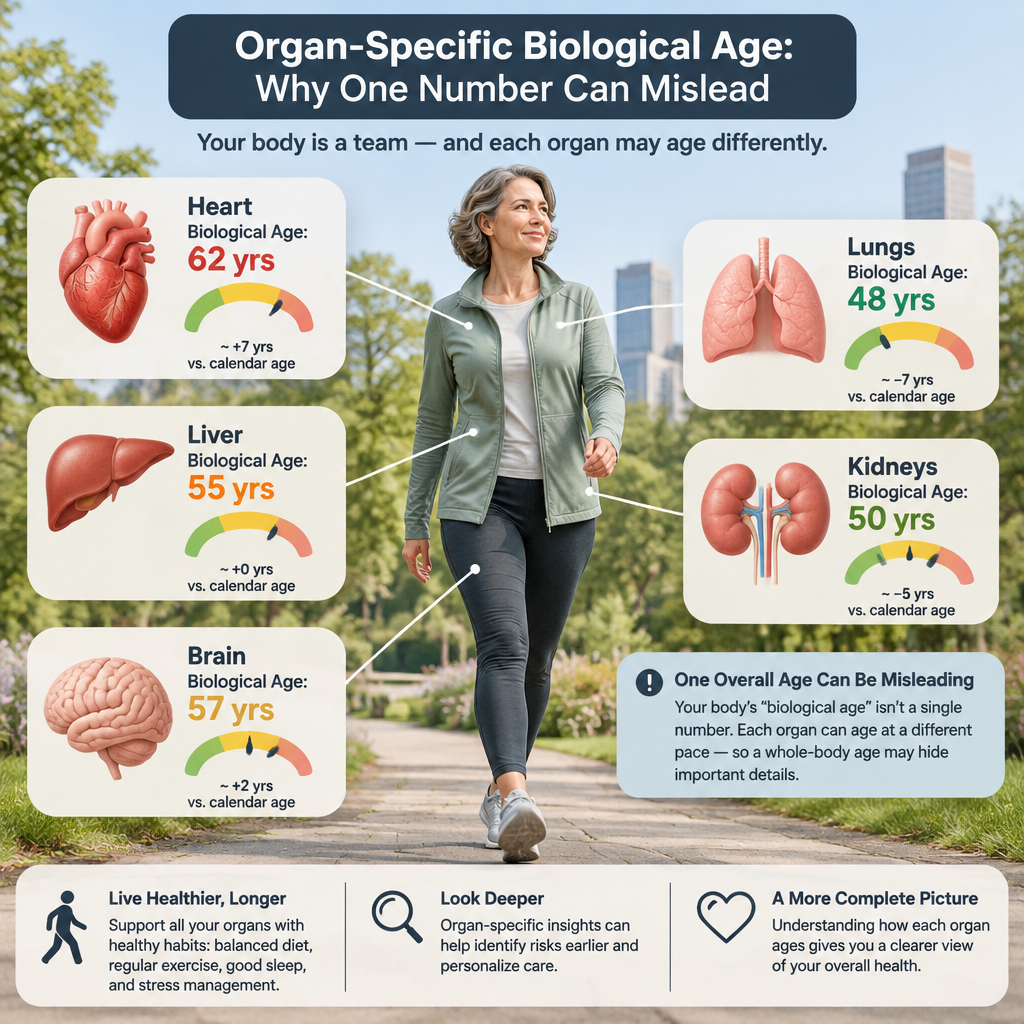
- Different organs can show different aging patterns, so a single average may conceal useful detail.
- Plasma proteomics can estimate organ-specific signals, but those estimates are not equivalent to direct organ measurements.
- Established clinical tests, medical history, and risk factors remain essential for decisions.
- Exercise, nutritious eating, sleep, and appropriate medical care matter more than chasing an unvalidated score.
A younger-than-expected result can feel reassuring. An older score can be unsettling, especially when it arrives with a polished chart and little explanation. Neither result should be treated like a verdict. The practical question is not whether a test can assign an age, but whether its findings lead to a reliable next step that improves health.
The distinction matters because the body does not age at one uniform rate. A person may have strong cardiovascular fitness while facing metabolic or kidney risks, and a composite score can blur those differences. Proteomic research is trying to sharpen the picture by examining patterns of proteins in blood and relating them to specific organs. That is promising science, not a license to diagnose disease from a consumer report.
What Is Organ-Specific Biological Age?
Chronological age is simple: it counts the years since birth. Biological age is a statistical estimate based on measurements associated with health, aging, or later-life outcomes. Depending on the test, those measurements may include routine blood markers, DNA methylation patterns, physical function, or circulating proteins. Different tests can produce different answers because they use different inputs, algorithms, and reference groups.
An organ-specific biological age estimate applies that idea to a particular system, such as the heart, brain, kidneys, liver, or immune system. It asks whether a pattern of measurements resembles the pattern more commonly seen in older or younger people in a reference population. That wording matters. An estimate of an organ’s age does not mean the organ has a literal, independently measurable birthday.
Proteomics is the large-scale study of proteins. Proteins perform much of the body’s working machinery: they carry signals, support immune activity, and participate in tissue repair and metabolism. Some proteins enter the bloodstream from particular tissues, and research teams can use protein patterns to build models associated with organ health. A 2023 study in Nature described organ-specific aging signatures in plasma proteins and reported associations with health and disease outcomes. Those findings support further study; they do not prove that a particular protein pattern causes disease or that acting on the score improves outcomes. Read the Nature study on organ aging signatures.
Blood is convenient to collect. It is not a direct camera pointed at an organ. A circulating protein may come from more than one tissue, and its level can shift with infection, inflammation, medication, recent exercise, or other conditions. Models infer patterns from groups of measurements; they do not inspect the kidney or brain itself. When I assess a biological-age claim, I look for the test’s intended use, validation population, and evidence that its result changes a useful clinical decision.
That is why the word “real-time” needs care. Proteins reflect active biology more directly than a fixed genetic sequence, but a single sample is still a snapshot influenced by timing and circumstances. Proteomic organ estimates are best understood as research-based risk signals, not standalone clinical measurements.

Why Organ-Level Detail May Matter
A single composite score is easy to understand. It is also easy to overinterpret. If a measure averages several systems, a strong signal in one organ may be softened by a different signal elsewhere. Organ-level estimates could help researchers and clinicians ask a more specific question: which system deserves closer examination, and what established test should follow?
- More focused follow-up: If a report flags a possible kidney-related pattern, a clinician can review blood pressure, medications, medical history, estimated glomerular filtration rate, and urine albumin rather than reacting to an overall aging number. A signal would prompt assessment, not establish kidney disease.
- A broader view of risk: Standard clinical markers remain valuable, but no single lab captures every aspect of health. A proteomic profile may add a research layer that helps generate a more precise question for a clinician.
- Better research tools: Organ-specific models may help researchers study why people with similar chronological ages develop different conditions, or identify groups that warrant closer monitoring in a clinical trial.
- A useful reminder about prevention: The score can direct attention toward ordinary risk factors that are sometimes ignored: blood pressure, smoking, activity, sleep, nutrition, and follow-up care.
Here’s the kicker: more detail does not automatically mean more certainty. A kidney-related score is not a kidney function test, just as a brain-related estimate is not a cognitive assessment. The value of extra resolution depends on whether it is accurate for the person being tested, whether the finding is confirmed, and whether a proven action follows.
For kidney assessment, clinicians commonly use established measures such as eGFR and urine albumin, interpreted alongside the full clinical picture. The National Institute of Diabetes and Digestive and Kidney Diseases explains eGFR, while KDIGO’s kidney disease guidance describes clinical evaluation and management. These tools have a defined place in care. An experimental proteomic estimate should not displace them.
There is also a patient-centered benefit when results are handled well. A conversation about a possible risk can create a chance to review habits and preventive care without pretending that aging itself is a disease to be defeated. Health deserves attention, but a person is more than a biomarker panel. Scores should support sensible care, not become a new source of shame or constant self-surveillance.
How to Use a Biological-Age Result: A Practical Guide
A report is only as useful as the decisions it supports. These steps keep the interpretation grounded and reduce the chance of turning an uncertain estimate into needless worry.
- Start with the reason for testing. Ask what question the test was meant to answer. Was it designed to estimate mortality risk, compare a biomarker pattern with age peers, or provide an organ-specific research score? If the report does not state its intended use clearly, treat its claims cautiously. A broad wellness result should not be mistaken for a diagnostic test.
- Check how the score was built. Find out which measurements were used, what population trained the model, and whether it was tested in a separate population. Ask whether the test has been independently validated, whether the laboratory uses quality controls, and how often results vary on repeat testing. A precise-looking number can still have substantial uncertainty. Frankly, the decimal places on a dashboard do not make the biology more precise.
- Review the result with a clinician who knows your history. Symptoms, family history, medication use, prior diagnoses, and recent illness can change the meaning of a result. Bring the full report, not just a screenshot of its headline score. A clinician can determine whether the finding fits existing information or conflicts with it.
- Confirm any concerning signal with accepted methods. If a kidney estimate looks unusual, ask whether conventional kidney assessment is appropriate. If a cardiovascular signal is raised, review established cardiovascular risk factors and tests rather than assuming the score identifies a specific problem. The right follow-up depends on the person; it is not a prewritten protocol attached to a result.
- Agree on a proportionate plan. A clinician might recommend routine monitoring, a standard test, or no additional testing, depending on the evidence. Do not start, stop, or change prescription medication based on an aging score alone. Nor should a score automatically trigger scans or specialist referrals without a clinical reason.
- Build the foundation that already has evidence. Regular physical activity supports cardiovascular and metabolic health. For most adults, the World Health Organization recommends 150–300 minutes of moderate-intensity aerobic activity, or 75–150 minutes of vigorous activity, per week, plus muscle-strengthening activity on two or more days. Adjust that target for health status, ability, and medical advice. See the WHO physical activity recommendations.
- Make nutrition and recovery practical. Favor a sustainable eating pattern with vegetables, fruit, legumes, whole grains, and appropriate sources of protein and unsaturated fats. Limit tobacco exposure and avoid treating supplements as a substitute for care. Give sleep and recovery a regular place in the plan; more punishing training is not automatically better training. If exercise is new or you have a chronic condition, ask a clinician how to begin safely.
- Decide in advance whether repeating the test would change anything. There is no universal repeat schedule for these scores. If no established action follows a small change, frequent retesting may add cost and anxiety without improving care. Track concrete measures that matter to your health plan, such as blood pressure, activity consistency, or clinician-recommended laboratory results.
Comparison: Organ-Specific Profiling vs. Aggregate Biological-Age Scores
There is no single best biological-age test for every purpose. The table compares two broad approaches, not every commercial product. Methods vary, and a model’s performance should be assessed on its own evidence rather than assumed from its category.
| Feature | Organ-specific proteomic profiling | Aggregate biological-age score |
|---|
| Main idea | Uses blood protein patterns to estimate signals associated with particular organs or systems. | Combines selected biomarkers into one overall age-like estimate. |
| Level of detail | Potentially separates patterns for organs such as the heart, liver, kidneys, or immune system. | Offers a simplified summary that may obscure differences between systems. |
| Potential use | Generate more specific research questions and possible prompts for clinically appropriate follow-up. | Offer a broad comparison with an age-based reference group or track a chosen algorithm’s output. |
| Key strength | May make uneven aging more visible than one blended number. | Easier to communicate and may be simpler to repeat using the same test. |
| Key limitation | Organ attribution is model-based; blood signals are not direct organ measurements, and clinical thresholds may be unsettled. | Averages can hide the source of a signal; results depend on the selected biomarkers and algorithm. |
| Clinical status | Promising research area; a score alone is not a diagnosis or treatment target. | Usually a wellness or risk-estimation measure unless validated for a specific clinical use. |
Which approach wins? Neither, by itself, is a substitute for a medical assessment. Organ-specific profiling offers a more granular hypothesis; an aggregate score offers a simpler summary. If the question is whether a person has a particular disease, established diagnostic criteria and validated tests remain the relevant tools. If the question is how to support health, preventive habits and appropriate medical care do not need a biological-age score to become worthwhile.
Common Mistakes to Avoid
Mistake 1: Treating the score as a diagnosis. A result that says an organ appears older than expected does not confirm organ damage or disease. It may be a statistical signal, an algorithmic artifact, or a temporary response to circumstances around the blood draw. The next step is interpretation and, if warranted, confirmation—not panic.
Mistake 2: Assuming that younger is always healthier. A score that is lower than chronological age may feel like good news, but it cannot guarantee protection from disease. Screening, symptoms, family history, and established risk factors still count. A favorable number should not be used to skip recommended care.
Mistake 3: Mistaking association for cause. If a protein pattern is associated with later disease, that does not show that changing the protein pattern will prevent the disease. A model may identify risk without revealing the mechanism. That distinction is basic science, not a technicality.
Mistake 4: Chasing the number with extreme habits. Restrictive diets, excessive exercise, unregulated supplements, and medication changes can cause real harm. Most longevity advice sounds certain because certainty sells. A sensible plan should be safe, sustainable, and tied to outcomes that matter—not built around manipulating an unvalidated score.
Mistake 5: Treating one panel as a replacement for routine care. A proteomic test does not replace blood-pressure checks, age-appropriate screening, kidney or liver evaluation when indicated, or conversations about symptoms. For consumer tests generally, the FDA’s direct-to-consumer test information explains why test claims, oversight, and interpretation deserve scrutiny.
Mistake 6: Ignoring context around the blood draw. Recent illness, hard exercise, medication changes, and other factors may affect circulating proteins. Ask the clinician or laboratory whether any preparation instructions apply, and report relevant circumstances. Do not assume that every fluctuation represents a change in the rate of aging.
Mistake 7: Letting a score dominate the conversation. A person’s health is not a leaderboard. If a result prompts persistent anxiety or repeated testing, step back and discuss the concern with a qualified clinician. The point of measurement is better care, not permanent vigilance. The body deserves respectful care; it does not need to be treated like a machine that must produce a younger number every quarter.
Frequently Asked Questions
Can a biological-age test tell me how long I will live?
No. A biological-age score cannot predict an individual lifespan with certainty. Some models may be associated with health outcomes across groups, but a population-level association does not provide a personal countdown. Genetics, environment, access to care, behavior, and chance all matter. Treat a score as an estimate generated by a specific method, not a forecast of your remaining years.
Is an organ-specific proteomic age test available as a routine clinical test?
Some companies offer consumer tests and researchers are developing organ-specific models, but availability does not establish clinical usefulness. A clinician should check whether the exact test has been validated for the decision at hand and whether it has accepted interpretation thresholds. For many organ-specific scores, the result is best regarded as a wellness or research signal rather than routine diagnostic evidence.
If my kidney age looks high, should I change my blood-pressure medication?
Do not change medication on the basis of that score alone. Discuss the report with your clinician, who can review blood pressure, other medicines, medical history, and accepted kidney measures such as eGFR and urine albumin when appropriate. Medication decisions depend on the complete clinical picture. A proteomic result may raise a question; it does not prescribe the answer.
Can exercise and diet reverse biological aging?
Exercise and a nutritious eating pattern support health and can improve important risk factors, fitness, and function. That does not mean a person can reliably reverse a biological-age score or turn back the age of an organ. Different tests respond differently, and evidence that a lifestyle change improves health is not the same as proof that it changes a particular aging clock. Build habits for their established benefits, not for a guaranteed score change.
A biological-age result can be a useful opening for a better health conversation. It can also be a shiny distraction, especially when a vendor makes a confident claim that outruns the evidence. The sensible response is to ask what was measured, what the score can actually support, and whether a reliable next step exists.
Proteomic research adds an important idea: the heart, brain, kidneys, liver, and immune system need not share one aging pattern. That insight may eventually help prevention become more specific. For now, an organ-level estimate is a clue to examine, not a diagnosis to obey. Confirm concerns with established clinical tools, and make decisions with someone who understands the person behind the report.
Training, food, sleep, and medical care are not glamorous shortcuts. They are the plain work that supports health across many systems, even when no score changes. A body is not a spreadsheet to optimize; caring for it is an act of stewardship, and moderation beats panic-driven experimentation. Let the number inform a conversation, then give greater weight to evidence, sound judgment, and habits you can sustain.