The Nobel Prize in Physiology or Medicine recognizes discoveries that have changed how we understand the body, disease, or treatment. Its greatest lesson is...
The Nobel Prize in Physiology or Medicine: How Science Changes What Medicine Can Do
The Nobel Prize in Physiology or Medicine recognizes discoveries that have changed how we understand the body, disease, or treatment. Its greatest lesson is not that one prize fixes medicine; it is that patient observation, experiments, and independent scrutiny can turn uncertain ideas into reliable knowledge that improves lives.
What Is the Nobel Prize in Physiology or Medicine?
The Nobel Prize in Physiology or Medicine is an annual award recognizing an important discovery in the life sciences or medicine. It is one of six original Nobel Prizes established through Alfred Nobel’s will. The award can recognize fundamental work on how organisms function, how diseases arise, or how medical understanding and treatment have advanced. It does not simply reward a popular therapy or a polished story.
The distinction matters. A prize is a recognition of scientific contribution, not a clinical practice guideline, product endorsement, or promise that a treatment will help every patient. Discoveries can take years to translate into everyday care. Some findings eventually produce a diagnostic test or therapy; others change the way researchers frame a problem, without leading directly to a prescription. The official Nobel Prize in Physiology or Medicine page lists laureates, citations, and background information on the award.
Each year, I find the ceremony useful for a reason beyond the medal: it offers a public reminder that medicine changes when evidence changes. A physician’s textbook is not a sacred object, and neither is the latest headline. Reliable knowledge is provisional in the sensible meaning of the word: it is held with confidence proportionate to the evidence, and revised when better evidence arrives. That is not weakness. It is how a disciplined field avoids confusing tradition with truth.
The excerpt this article is based on was dated October 7, 2026, but it stops just before naming that year’s award recipient or recipients. That missing information cannot responsibly be filled in by inference. Nobel announcements are time-specific, so anyone writing about the 2026 award should verify the official prize announcement and reproduce its wording accurately. The structure of the award and the principles behind biomedical research can still be discussed without inventing a result.
Frankly, that restraint is part of the point. In science, an incomplete source is not an invitation to fill the gap with a plausible-sounding answer. It is a reason to check. A prize can draw attention to years of research, but the public should still ask what was discovered, how the conclusion was reached, how strong the evidence is, and what remains uncertain.
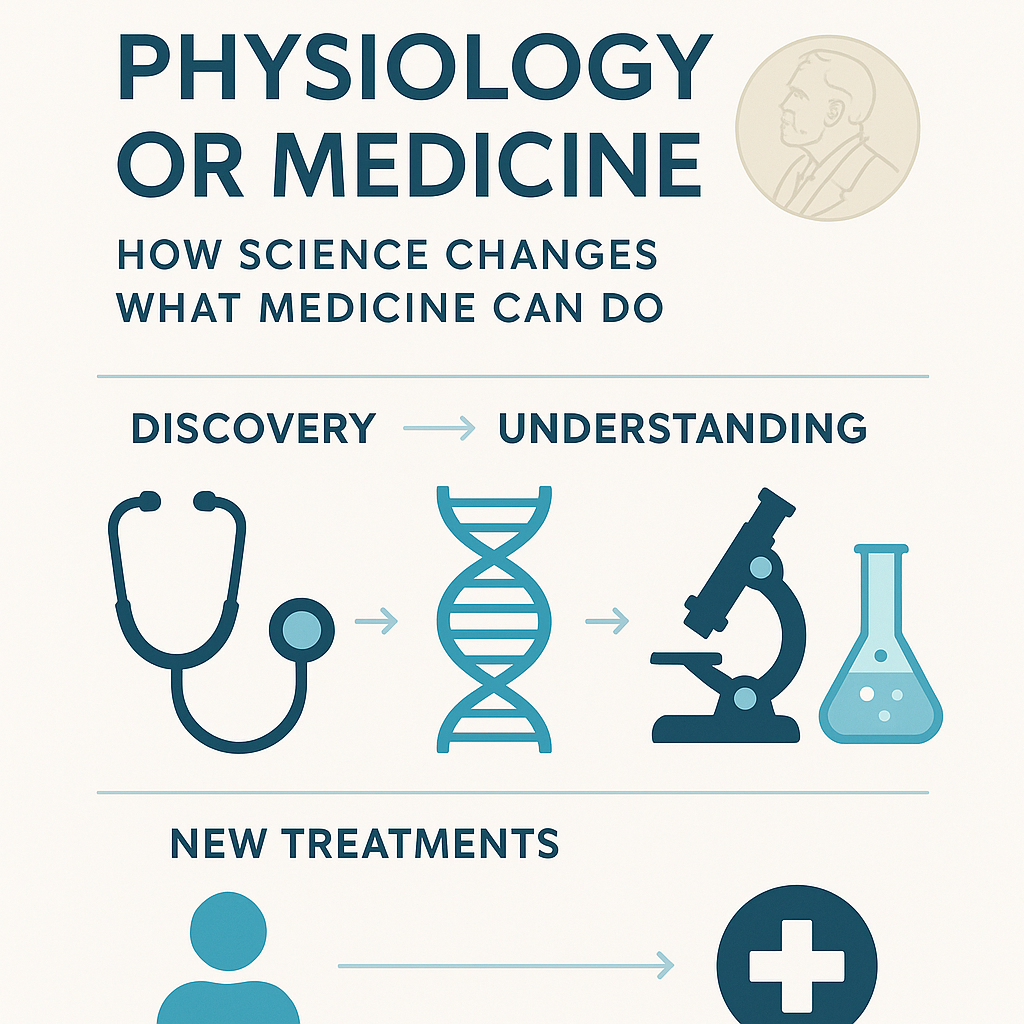
Why the Prize Matters: The Benefits of Scientific Discovery
The most valuable medical discoveries often begin far from a hospital bed. Researchers may study a cell, a molecule, a microbe, a gene, or an unexpected pattern in patient records. Their first question may not sound like a treatment question at all. Yet careful work on basic biology can later help explain why a disease develops, identify a useful biomarker, or suggest where a therapy might act.
That process is not a straight line. Basic research creates possible explanations; experiments test them; other teams try to reproduce the findings; and clinical researchers examine whether an intervention is safe and useful in people. The National Institutes of Health describes its role in supporting research and its effects on health in its overview of the impact of NIH research. The broad lesson is that medical advances depend on a chain of work, not a single flash of inspiration.
A major discovery can matter in several ways:
- It can explain a mechanism. Understanding how a biological process works may identify where disease begins or how it progresses. An explanation is not yet a cure, but it can narrow the questions researchers need to test.
- It can improve diagnosis. Better knowledge may support tests that identify disease earlier, distinguish one condition from another, or help clinicians choose an appropriate next step.
- It can guide treatment research. A new biological insight can suggest a target for medicines or other interventions. Whether that target leads to a safe, effective treatment is a separate question requiring further study.
- It can change future research. A discovery may give researchers a new tool or model, allowing them to ask questions that were previously difficult to answer.
- It can improve public understanding. A well-explained prize can show that progress depends on evidence, collaboration, and years of work, rather than miraculous claims or individual genius alone.
Here’s the kicker: a striking discovery is not automatically a health benefit in the clinic. Early results can be promising and still fail to produce an effective treatment. A finding may apply to a narrow group, work only under specific conditions, or have side effects that change the balance of benefit and risk. The responsible response is neither to dismiss new science nor to advertise it as a miracle.
The award also highlights an ethical point. Research should respect the people who participate in it, protect their dignity, and communicate uncertainty honestly. Health is not merely a machine to optimize; a person’s body deserves care and respect. Good medicine combines technical skill with stewardship, moderation, and concern for the individual living with the diagnosis.
From Discovery to Care: A Step-by-Step Guide to Reading Medical News
A Nobel announcement can prompt understandable excitement. It can also produce headlines that leap from a laboratory discovery to a claim that a cure is around the corner. When I analyze medical news, I use a few practical checks before deciding what a result actually means.
- Find the original announcement. Start with the Nobel Foundation’s official page or press release, not a social post summarizing it. Confirm the laureates’ names, the wording of the award citation, and the discovery being recognized. If a source ends before the award is named, as the supplied excerpt does, do not guess.
- Identify the kind of research. Was the work conducted in cells, animals, a laboratory model, or people? Each type can answer different questions. A result in a controlled laboratory setting may reveal a mechanism, but it cannot by itself establish that a treatment benefits patients.
- Separate discovery from application. Ask whether the award recognizes an explanation, a research method, a diagnostic advance, or a therapy. These are meaningful contributions, but they are not interchangeable. A biological insight may be a starting point rather than a product ready for clinical use.
- Look for evidence beyond one report. Has the work been replicated by independent groups? Do systematic reviews or later studies support the same conclusion? One result can be useful, but repeated findings under appropriate conditions provide stronger grounds for confidence.
- Check whether people were studied. If the claim concerns treatment, look for clinical trials and information about participants, comparison groups, outcomes, duration, and adverse effects. A study showing a change in a laboratory marker does not necessarily show that patients feel better, live longer, or function better.
- Ask how large and relevant the effect is. Statistical significance alone does not tell a patient whether a benefit is substantial. Consider the absolute effect, the likely harms, the population studied, and whether the outcomes matter in daily life.
- Keep the timeline in view. Translating a discovery into care can require years of testing, review, and monitoring. Some ideas do not make it through that process. That is not a failure of science; testing is how weak or unsafe ideas are identified before they become routine practice.
- Discuss personal decisions with a clinician. A prize does not replace individual medical advice. A patient’s history, other treatments, preferences, and risks matter. Do not start, stop, or substitute treatment based on an award headline.
Let’s be real: these checks are less exciting than a claim that a single discovery will transform everything by next Tuesday. They are also more useful. A Nobel prize announcement can point readers toward important science; it cannot tell them whether an experimental approach suits their own condition. That requires evidence at the right stage and a clinician who understands the person, not just the headline.
The research process includes scientists, clinicians, statisticians, technicians, research participants, funders, and regulators. Credit may be awarded to a small number of laureates, but modern biomedical work is rarely the product of one person acting alone. The prize marks exceptional contributions within a much larger enterprise. Remembering that keeps the story accurate and gives due respect to the many people whose labor makes reliable results possible.

Comparison: Biomedical Research and Alternative-Medicine Claims
The supplied excerpt contrasts scientific medicine with alternative medicine, criticizing claims that recycle older ideas under newer marketing. That criticism is strongest when it names the difference in methods rather than relying on insults. Some approaches described as alternative have been tested and found useful for particular purposes; others lack credible evidence, rest on claims that are difficult to test, or are promoted beyond what the evidence supports. The label alone does not establish whether something works.
The more useful comparison is between a claim that can be tested and one that avoids meaningful testing. Scientific medicine is not infallible. Studies can be flawed, commercial incentives can distort communication, and professional guidance can lag behind new evidence. The scientific approach has a way to find and correct some of those failures: transparent methods, independent scrutiny, replication, and revision. A treatment claim should be judged by the quality of its evidence, not by whether it sounds ancient, modern, natural, or impressive.
| Feature | Evidence-based biomedical research | Unsupported or weakly tested health claim |
|---|
| Main question | Does the intervention reliably produce a meaningful benefit, and what risks accompany it? | Often asks whether an idea sounds plausible or fits a preferred explanation. |
| Testing | Uses methods suited to the question, such as controlled experiments, observational research, or clinical trials. | May rely mainly on testimonials, tradition, anecdotes, or explanations that are hard to disprove. |
| Independent scrutiny | Methods and findings can be examined, challenged, and, where possible, repeated by other researchers. | Independent testing may be limited, discouraged, or replaced by claims that critics simply do not understand the method. |
| Uncertainty | Communicates limits and can revise conclusions when stronger evidence appears. | May state certainty despite limited evidence, or dismiss negative findings without a testable reason. |
| Safety | Evaluates likely harms alongside possible benefits, with attention to dosage, interactions, and the people studied. | May describe something as harmless because it is natural, traditional, or non-invasive, without adequate evidence. |
| Practical conclusion | Recommendations depend on evidence quality, risk, patient context, and clinical judgment. | Marketing may promise broad benefits that have not been demonstrated. |
The table is a guide, not a verdict on every practice or practitioner. A familiar treatment deserves the same scrutiny as an unconventional one. Researchers should also be alert to publication bias, selective reporting, conflicts of interest, and the temptation to make a small result sound larger than it is. Skepticism is not a weapon reserved for ideas one dislikes; it is a method applied in both directions.
The National Center for Complementary and Integrative Health explains its approach to evaluating complementary health practices and evidence on its About NCCIH page. Its existence does not mean every product or practice is effective. It reinforces a more basic rule: assess each claim according to the evidence for that specific claim. A therapy that helps one symptom does not thereby prove an entire theory about energy fields or bodily balance.
Most fitness and health advice is not improved by calling people fools. It improves when claims are made precise enough to test. What outcome is expected? Compared with what? Over what period? What are the risks? If supporters can answer those questions and accept the result of a fair test, useful evidence can emerge. If a claim changes shape whenever it is challenged, consumers should be cautious.
Common Mistakes to Avoid
Medical news is easy to misread, especially when the discovery is genuinely exciting. These are the errors most likely to turn a useful announcement into confusion.
- Treating the prize as proof of a cure. A Nobel Prize recognizes a contribution; it does not certify that a corresponding intervention is widely available, suitable for every patient, or ready for routine use. Ask what the research actually established.
- Confusing basic research with a clinical recommendation. Discovering how a process works can be a major advance. It still takes additional evidence to determine whether changing that process helps people and what trade-offs come with the intervention.
- Reading a headline instead of the source. Headlines compress and simplify. The official announcement provides a more reliable account of the prize citation. For the 2026 award in this case, the provided excerpt stops before the winners are named, so a responsible rewrite does not insert names or discoveries that are not in the source.
- Assuming that one study settles a question. Studies vary in design and quality. Results can be affected by small samples, weak comparison groups, selective reporting, and chance. Replication and synthesis matter.
- Mistaking plausibility for proof. A mechanism that sounds tidy is not the same as evidence that a treatment improves health. Nature is not a guarantee of safety, and technological sophistication is not a guarantee of benefit.
- Assuming that all alternative practices are identical. The label covers many different interventions and claims. Some may be testable and worth studying; others may lack credible support. Evaluate the specific claim rather than deciding by label alone.
- Treating skepticism as cynicism. Skepticism asks for good evidence and changes its mind when evidence warrants it. Cynicism dismisses the possibility of progress in advance. Neither blind faith nor reflexive dismissal is a sound way to understand medicine.
- Forgetting people behind the data. Research participants are not abstractions. Ethical research requires informed participation, protection, and honest reporting. A promising result never excuses treating people as mere tools for an exciting discovery.
Here’s what nobody tells you in some breathless coverage: the slow, cautious parts are often the reason medical progress can be trusted. Replication, careful trial design, adverse-event monitoring, and independent review may not make a dramatic headline, but they help reveal where a finding holds and where it does not. Scientific institutions deserve scrutiny; their methods deserve attention too.
There is a second trap: treating science and medicine as if they were the same thing. Research produces knowledge about populations and mechanisms. Clinicians apply that knowledge to individuals, whose health histories and priorities differ. A statistically useful intervention may be wrong for a particular patient. That is why clinical judgment, informed consent, and open conversation remain essential even when the underlying research is strong.
Finally, do not assume that a discovery instantly changes practice. Medical systems need training, access, funding, and sensible guidance before a validated advance can reach people equitably. A finding can be scientifically sound and still fail to benefit everyone if it is expensive, difficult to deliver, or poorly integrated into care. Progress is not only discovering what might work; it is responsibly making proven care available.
Frequently Asked Questions
What does the Nobel Prize in Physiology or Medicine recognize?
It recognizes discoveries judged to have made an important contribution to physiology or medicine. The award can honor fundamental biological research as well as work that has altered medical understanding. It is a recognition of scientific contribution, not a general seal of approval for every treatment associated with the field.
Does a Nobel Prize mean a treatment is available to patients?
No. A prize may recognize an underlying discovery or research advance, not a finished therapy. Any proposed treatment still needs suitable testing for effectiveness, safety, and relevance to the people who might use it. Availability and clinical recommendations depend on separate evidence and regulatory processes.
Why does basic research matter if it does not immediately treat disease?
Basic research helps explain how biological systems work and where disease processes may begin. Those explanations can shape later diagnostic or treatment research. The path is uncertain: some findings lead to practical advances, while others mainly improve understanding or do not hold up under further testing.
How can I tell whether a medical claim is well supported?
Look for relevant human studies when the claim concerns treatment, a clear comparison group, meaningful outcomes, transparent risks, and independent confirmation. Check whether the evidence has been reviewed systematically and whether reputable clinical guidance supports the claim. Be wary of testimonials, guaranteed results, and claims that dismiss all contrary evidence without a testable explanation.
Final Thought
The Nobel Prize can make a complicated research story visible for a moment. That moment is worth using well. Rather than treating the medal as a magic stamp, ask what the laureates found, what evidence supports it, what remains unknown, and what further steps would be needed before it changes patient care. The best account of medical progress is often more patient than a headline: discovery, testing, correction, and then—if the evidence holds—careful use.
The excerpt provided here leaves the central 2026 detail unfinished. That is a limitation of the source, not a license to improvise. The right next step is to consult the official Nobel announcement, confirm the exact laureates and citation, and add that information only after verification. Accuracy is not a fussy extra. In health writing, it is part of the care owed to readers.
There is room for admiration without worship and skepticism without sneering. Scientific institutions make mistakes, and claims outside conventional medicine can sometimes merit fair testing. But when people’s health is at stake, a story, tradition, or confident explanation cannot substitute for evidence that survives scrutiny. Our bodies deserve respect, and that includes resisting both neglect and careless promises. Health is a gift to steward with good judgment, moderation, and honest attention to what is known.
A prize is one day on a long calendar of research. The real measure is whether dependable knowledge eventually helps people live healthier lives, with fewer harms and more informed choices. That work rarely fits on a medal. It is still the work that matters.