Approved generic GLP-1 versions are a big deal. They may shrink the compounding grey market, but they will not erase it overnight, because price, supply...
Approved generic GLP-1 versions are a big deal. They may shrink the compounding grey market, but they will not erase it overnight, because price, supply, insurance coverage, and patient access still matter, and the rules around what pharmacies can legally compound are tighter than the marketing hype suggests. What actually changes?
Key Takeaways- Generic GLP-1 approvals can lower prices, but access will still vary.
- The compounding market exists because shortages, cost, and insurance gaps created demand.
- A generic does not automatically mean every patient can get it cheaply.
- Regulators still police unapproved compounded versions, especially when supply problems ease.
- The real fix is not one pill, but better pricing, coverage, and clear prescribing rules.
What is the GLP-1 compounding grey market?
The short version is simple. Compounded GLP-1 drugs are pharmacy-made versions of medicines like semaglutide, prepared when patients and prescribers cannot get the branded product, or when a pharmacy claims a specific formulation is needed. That sounds tidy, but the reality has been messy, because some compounders and telehealth sellers pushed versions with unclear quality, unclear dosing, and, in some cases, active ingredients that were not truly equivalent to the approved drug. Frankly, that is where the trouble starts.
Most people use the term grey market because the line between lawful compounding and illegal manufacturing can get blurry fast. The FDA has warned repeatedly about compounded semaglutide products, including dosing errors and salt forms that are not the same as the approved active ingredient in Ozempic or Wegovy. I’ve looked at enough of these cases to say this plainly: when a drug becomes scarce and expensive, entrepreneurs rush in, and not all of them are careful. That is not medicine. That is opportunism wearing a white coat.
The approved generic versions change the equation, but only partly. Once a legitimate generic enters the market, the argument that a patient needs a compounded substitute gets weaker, especially if the product is available through normal channels. But compounding does not vanish just because a generic exists. There can still be shortages, insurance barriers, dose adjustments, and intolerance issues that keep some compounding legal and appropriate. The real question is not whether compounding disappears. It is whether the market gets disciplined enough that the sketchy stuff dries up.
For background on how regulators view these products, see the FDA’s guidance on compounded semaglutide and related risks at FDA: Concerns with GLP-1 Drugs and Compounded Semaglutide. For broader clinical evidence on GLP-1 efficacy and safety, the major trial data summarized by the National Institutes of Health and published studies are the real anchor, not influencer anecdotes. Bodies are not disposable. They deserve careful stewardship.

Core benefits and why this matters
This is about more than a cheaper prescription. It is about patient safety, market pressure, and whether access gets better without inviting sloppy shortcuts. The hype says generics fix everything. The truth is more annoying.
- Lower cost pressure: A generic semaglutide should, in theory, reduce prices compared with the branded product, which can improve access for people paying cash. That matters. A lot.
- Less incentive for risky compounding: If a legitimate product is easier to obtain, fewer patients will feel forced into the grey market. Will that happen everywhere? No. But it should reduce demand.
- Better prescribing clarity: Approved generics bring standardized labeling, consistent dosing, and a clearer adverse-event profile. That beats guesswork from sketchy online sellers, every time.
- More insurance leverage: Payers are more likely to cover a generic than a premium brand, though coverage rules can still be stingy. Insurance companies love a bargain, provided it is their bargain.
- Public health cleanup: The FDA and state boards can focus enforcement on truly noncompliant compounders rather than a market propped up by scarcity.
Here’s the kicker. Cheap does not always mean available. Even when generics arrive, some pharmacies stock out, some plans exclude weight-loss drugs, and some patients need titration schedules that not every clinic handles well. So the compounding market may shrink, then persist in pockets where the system still fails. That is the part the glossy headlines skip.
I’ve analyzed enough medication access problems to know this: when supply is spotty and administrative friction is high, people will buy from whoever promises speed. That is why a legitimate generic is helpful, but not magical. It can reduce the problem, not erase human impatience or bad salesmanship. And we have to keep moral order in view too—health is a gift to steward, not a toy to chase vanity with or a commodity to exploit.
For readers who want the clinical side of GLP-1 therapy, the NIH overview of semaglutide research is a cleaner starting point than social media sludge. Most fitness and health advice is noisy. Evidence is calmer.
Step-by-step: what happens when generics arrive?
The process is less dramatic than the headlines make it sound. Still, it matters, and the order of events is not hard to track.
- A generic gets approved.
The FDA requires bioequivalence evidence, quality manufacturing standards, and consistent labeling. That means the product should behave like the branded drug within accepted limits. No magic. Just chemistry and paperwork.
- Market pricing shifts.
If there is real competition, the price can fall. Sometimes it falls a little. Sometimes a lot. It depends on how many manufacturers enter, what the insurer does, and whether wholesalers play nice. They usually do not, by the way.
- Pharmacies and plans update formularies.
Some patients will move from branded Ozempic to a generic equivalent if their prescriber agrees and the plan covers it. That is the cleanest path, and it is the one regulators prefer.
- Compounders lose some legal and commercial cover.
If the approved product is available, the rationale for compounding weakens. That does not eliminate every legitimate compounded prescription, especially if a patient needs a different dose form or cannot tolerate a specific excipient, but it does narrow the field.
- Enforcement gets sharper.
Regulators can target bad actors more directly, especially those selling products that are not truly equivalent or that are made under questionable conditions. This is where the rubber meets the road.
- Some grey market demand remains.
This is unavoidable. Some people will still want faster access, some will still chase lower prices, and some will still distrust insurers or brick-and-mortar pharmacies. Human nature is stubborn.
In my analysis, the biggest determinant is not FDA approval alone. It is the combination of manufacturing scale, payer coverage, and prescriber behavior. If doctors default to the approved product and insurers stop throwing sand in the gears, compounding shrinks faster. If not, the market lingers.
The practical advice is plain. Patients should ask whether the medicine is FDA-approved, what the active ingredient is, whether the pharmacy is licensed, and whether the dose is being drawn from a compounded vial or an approved pen. If the answer is fuzzy, that is a red flag. Frankly, a fuzzy answer in medicine is usually a bad sign.
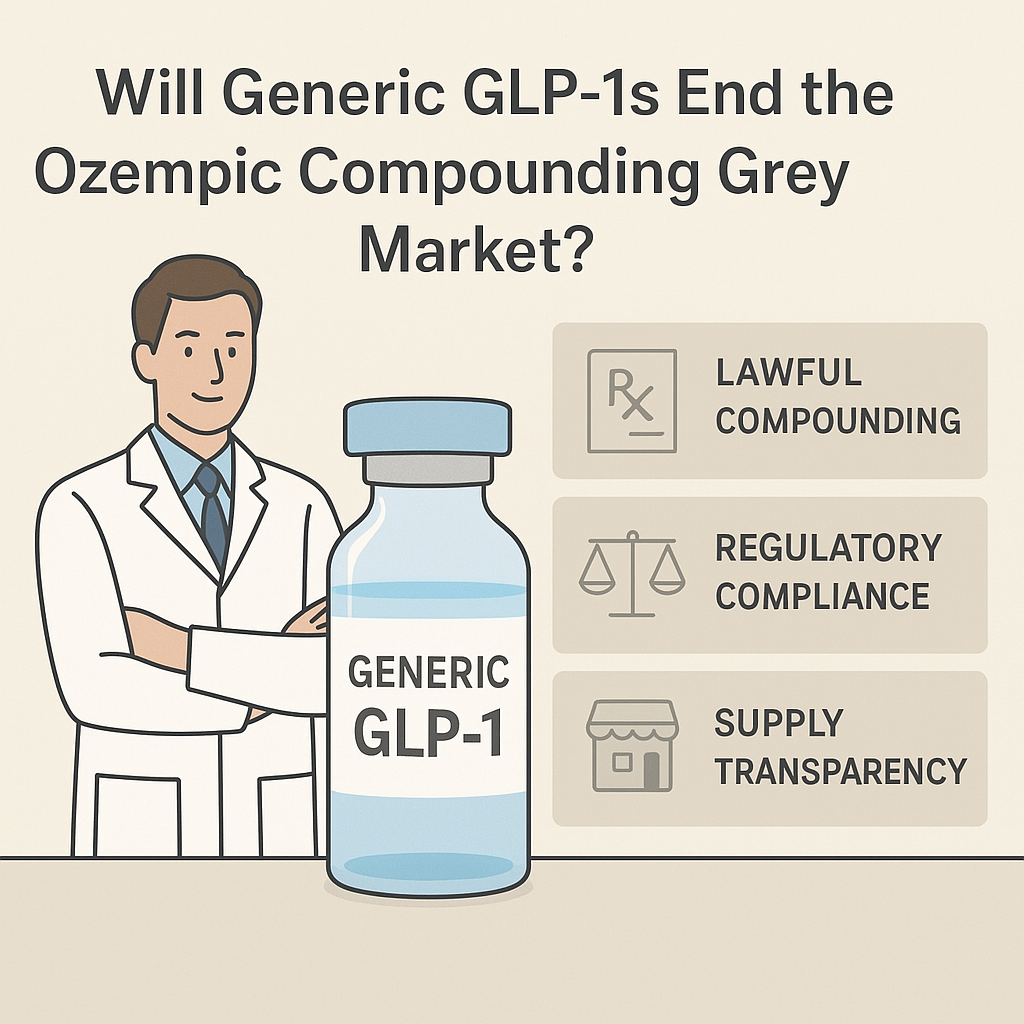
For more on regulatory standards, see FDA: Human Drug Compounding and FDA alerts on compounded semaglutide dosing errors. Those are the grown-up sources.
Comparison table: branded Ozempic vs. generic GLP-1 vs. compounded semaglutide
| Feature | Branded Ozempic | Approved Generic GLP-1 | Compounded Semaglutide |
|---|
| Regulatory status | FDA-approved brand | FDA-approved generic | Not FDA-approved as a mass-market substitute |
| Ingredient consistency | Standardized | Standardized | Can vary by pharmacy and batch |
| Price | Highest | Usually lower | Often lowest upfront, but variable |
| Supply reliability | Can still be constrained | Better if multiple manufacturers enter | Depends on local compounder and supply chain |
| Safety oversight | Strongest | Strong | Weaker, with higher risk of errors |
| Insurance coverage | Varies, often limited for weight loss | Potentially better | Usually poor or absent |
| Best use case | Patients with coverage and access | Patients needing lower-cost approved therapy | Narrow cases when lawful compounding is appropriate |
The table tells the story. Approved generics are the strongest competitor to the grey market because they offer a lawful, standardized alternative at a lower price. Compounded products survive on scarcity, speed, and confusion. That is a fragile business model, even if it has been lucrative.
Common mistakes to avoid
People make this harder than it needs to be. That is the annoying part.
- Assuming all GLP-1 products are interchangeable. They are not. Brand, generic, and compounded products can differ in quality, delivery device, and oversight.
- Trusting any clinic with a checkout page. If the site sells a miracle and skips real prescribing steps, walk away. Fast.
- Confusing semaglutide salts with semaglutide base. The FDA has warned that some compounded products use salt forms that are not the approved active ingredient. That is not a detail; it is the whole ballgame.
- Ignoring dosing errors. Compounded injectables can be mislabeled or mismeasured, and some patients have ended up with adverse events because they were not shown how to use the product correctly.
- Thinking cheap equals safe. It does not. Cheap sushi, cheap ladders, cheap medicine—same lesson.
- Believing generics erase regulation. Approved generics expand access, but they do not repeal the need for licensing, quality control, and honest prescribing.
Here’s what nobody tells you. When a medication becomes fashionable, the market fills with pretenders. Supplements did this for years. GLP-1s are doing it now. The best defense is dull old discipline: use licensed pharmacies, verify the prescription, and ask where the drug came from. No glamour. Just prudence.
I’ve seen enough training and nutrition fads to know the pattern. Whenever a solution gets popular, a second industry appears to sell shortcuts around the original problem. The shortcut is almost always sloppier than the thing it pretends to replace. Moderation, patience, and respect for the body beat cleverness more often than the internet admits.
Frequently Asked Questions
Will generic Ozempic completely end compounded semaglutide?
No. It will likely reduce demand, but not eliminate compounding. Some lawful compounding may still occur for patient-specific needs, and some grey market activity may persist where prices or access remain poor.
Are compounded semaglutide products the same as Ozempic?
Usually not. Some may claim similarity, but quality, ingredient form, sterility, and dosing consistency can differ. The FDA has warned that some products are not equivalent and may carry added risks.
Why do people buy compounded GLP-1s at all?
Mostly because of cost, shortages, or lack of insurance coverage. Speed and convenience also play a role. People want the medicine now, not after three prior authorizations and a polite game of bureaucratic ping-pong.
What should I ask before using a GLP-1 from a compounder?
Ask whether it is FDA-approved, what exact active ingredient is used, whether the pharmacy is licensed in your state, how the dose is measured, and whether the prescriber is managing follow-up. If they dodge the questions, that answers the question.
Final thought
Approved generics are a serious step forward. They should make the market cleaner, safer, and less dependent on borderline sellers who thrive when access is broken. But this will not be a neat victory lap. Real-world medicine rarely is.
The compounding grey market exists because people want treatment that is affordable, available, and simple. Those are not unreasonable desires. The problem is that bad actors exploit them, and weak systems leave room for that abuse. If approved generic GLP-1s do their job, the grey market should shrink hard. If prices stay high, coverage stays stingy, and oversight stays thin, some of it will hang around like mold in a damp basement.
The sane answer is not hysteria. It is clear rules, honest prescribing, and access that does not force patients into shady corners. Health care ought to respect the body, not treat it like a product to be squeezed. That principle is old, and it still beats clever marketing.